
The Challenge
From Fragmented Pipeline Reviews to a Common Portfolio Decision Framework
The client had a well-established pipeline review process, but each function approached prioritization differently.
R&D focused on development feasibility, clinical requirements, and timelines. Market Access considered payer dynamics, switching requirements, and reimbursement complexity. Commercial assessed market opportunity, competitive intensity, forecast sales, and net present value (NPV).
The challenge was not a lack of data. Each function had access to relevant information and established external sources, including DRG, Biomedtracker, Evaluate Pharma, and IQVIA.
The challenge was that these inputs were being evaluated separately, using different assumptions, data cuts, and review cycles.
As a result, the same asset could appear differently depending on which functional lens was being applied. Changes in competition, pricing, patent timing, or access conditions could also occur between formal review cycles without being reflected consistently in portfolio priorities.
Leadership needed a way to look at the pipeline across functions, using the same underlying evidence and a consistent set of decision criteria.
This created three practical challenges:
Fragmented portfolio view
No single, asset-level view across development stage, indication, geography, modality, and commercial potential.
Inconsistent prioritization
Functions assessed the same assets against different criteria, making cross-functional prioritization difficult.
Periodic decision-making
Rankings were typically revisited during scheduled review cycles, making it difficult to reflect changes in competition, pricing, patent timing, or market access as they emerged.
Limited scenario testing
Leadership had limited ability to understand how pipeline priorities would change when key assumptions – such as entrant numbers, price erosion, or launch sequencing changed.
The need was therefore not another pipeline ranking, but a common decision framework that could bring development, access, and commercial considerations into the same view.
Our Solution
Chryselys developed a unified pipeline intelligence framework that combined internal portfolio information with external market and competitive data and applied a consistent scoring methodology across assets.
The solution brought together four interconnected areas:
Portfolio Management
A centralized asset-level view covering development stage, indication, geography, modality, and other key portfolio attributes, providing a common starting point for all functions.
Value Assessment
Assessment of market opportunity, competitive intensity, pricing dynamics, potential price erosion, and portfolio fit.
Risk & Probability
Evaluation of clinical and development risk, regulatory complexity, access considerations, manufacturing and supply requirements, and timing dependencies.
Scenario & Prioritization
An interactive model that allowed leadership to change key assumptions and see how the relative prioritization of assets changed under different scenarios.
The framework was supported by desk research and licensed sources, including DRG, Biomedtracker, Evaluate Pharma, IQVIA and others
Where each asset sits
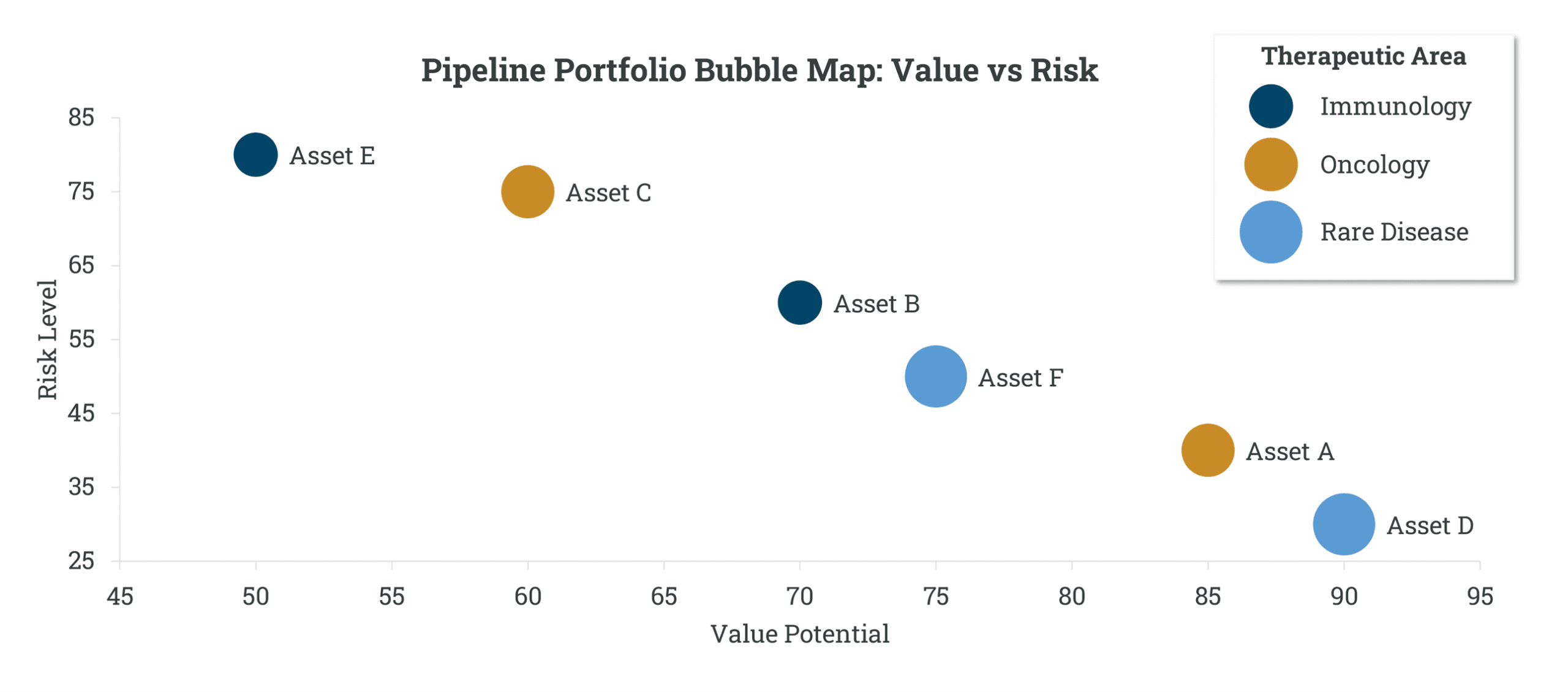
Bringing the portfolio into one view
The framework positioned each asset based on its value potential and risk, while allowing the portfolio to be viewed by therapeutic area and other relevant dimensions.
This helped distinguish assets with a relatively attractive combination of value and execution characteristics from those where the expected opportunity was less aligned with the level of risk involved.
A common scoring framework
Assets were assessed across three primary dimensions:
Commercial attractiveness
- Market opportunity and growth
- Expected product sales
- Competitive and biosimilar intensity
- Price erosion
Regulatory & launch attractiveness
- Patent and exclusivity timing
- Clinical development requirements
- Manufacturing and supply considerations
- Regulatory pathway and precedent
- Launch sequencing
Market access attractiveness
- Payer willingness to prefer biosimilars
- Buy-and-bill vs. pharmacy benefit dynamics
- Policy and guideline considerations
- Interchangeability
- Provider switching and administrative burden
Rather than allowing any single dimension to determine prioritization, the framework brought these factors together using a common weighting and scoring approach.
Translating the analysis into portfolio decisions
The resulting scores were visualized through a decision matrix mapping regulatory readiness against market access strength.
This created four practical portfolio categories:
Core Bets – Go / Prioritize
Assets combining stronger access prospects, regulatory readiness, and attractive value potential.
Access-Led Opportunities – Selective Go
Assets with attractive value potential where access considerations support the opportunity, but regulatory or execution risks require closer management.
Optional / Watchlist – Defer
Assets with moderate potential where access or execution risks warrant further monitoring before committing additional resources.
Value Traps – No-Go
Assets where the expected value did not sufficiently offset access, regulatory, or execution risks.
The categories were intended as decision aids rather than standalone recommendations, with the underlying score and assumptions providing the rationale for each placement.
Business Impact
A shared basis for cross-functional prioritization
R&D, Market Access, and Commercial could evaluate the same portfolio using a common set of criteria and assumptions, reducing the reliance on function-specific rankings during portfolio discussions.
Earlier visibility into access constraints
Access considerations such as payer preference, interchangeability, and switching burden were assessed alongside commercial and development factors, allowing potential access challenges to be considered earlier in the pipeline evaluation.
Greater transparency around prioritization
The framework made it clearer why assets moved up or down the priority list by linking each position to defined value, risk, regulatory, and access factors.
More informed scenario planning
Leadership could test alternative assumptions around competition, pricing, and launch sequencing and assess how sensitive portfolio priorities were to those changes.
A clearer basis for resource allocation
By distinguishing core opportunities from assets requiring further monitoring or carrying a higher level of risk, the framework provided a more structured basis for discussions around where to focus development and commercial resources.