
Executive Summary:
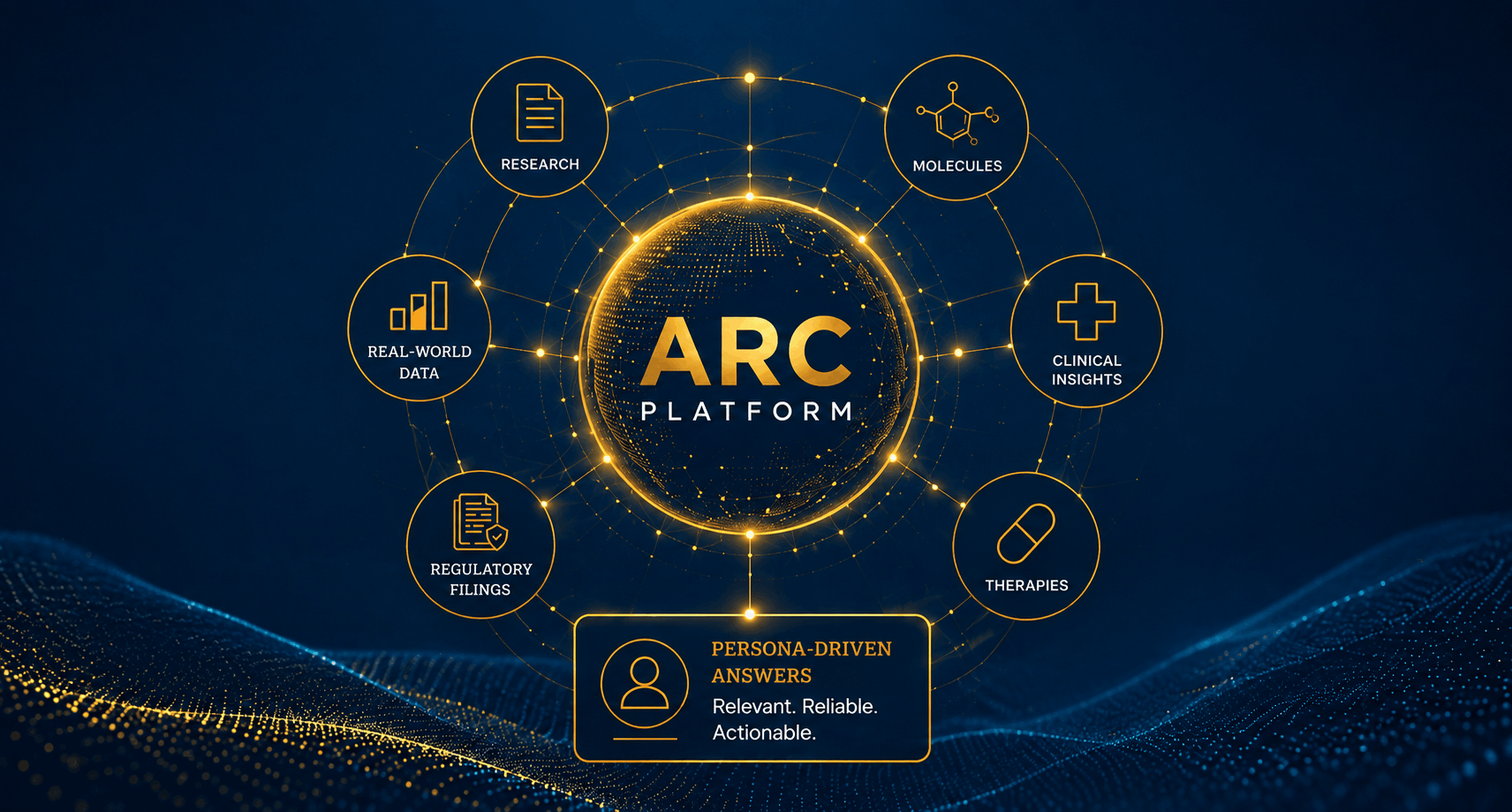
Enterprises don’t need more links, they need trusted answers in seconds. The Automatic Research and Comprehension (ARC) platform combines disciplined web-scale retrieval with generative AI to deliver concise, cited responses to complex questions. ARC systematically aggregates content from approved, public sources; scores evidence using E-E-A-T–aligned quality signals; synthesizes answers; and anchors every claim to source-level citations. The result is faster time-to-insight, higher confidence, and audit-ready provenance.
Following FDA approval of a new therapy, organizations must quickly understand market dynamics, competitive reactions, and regulatory developments. ARC enables this by transforming fragmented external data into trusted, cited intelligence in seconds.
By automating research workflows, ARC can reduce analyst effort by up to 75% and significantly accelerate decision-making. The platform also strengthens compliance through automatic citations and audit trails, while providing enterprise controls such as URL allowlists, configurable crawl depth, multi-model summarization, and secure processing without training models on proprietary data.
This paper outlines the problem (search-to-insight friction), ARC’s architecture, evaluation approach, results from production use, and guardrails for security, privacy, and compliance. A phased adoption plan enables measurable value within 30 days.
Note: ARC respects websites’ terms and robots.txt directives and is not affiliated with any search engine vendor. E-E-A-T is applied internally as a quality heuristic and does not imply claims about search ranking
Introduction:
Knowledge workers spend significant time navigating links, validating claims, and reconciling conflicting sources. Traditional search optimizes for navigation and monetization—not for synthesizing verified, domain-specific answers. Generative AI can compress comprehension time, but only when paired with trustworthy retrieval, quality scoring, and citations. ARC operationalizes that stack to deliver decision-ready answers with provenance in seconds.
The Challenge: Search-to-Insight Friction
Information is abundant, but transforming raw content into actionable intelligence is slow and error prone.
User behaviour and pain points
- 26% of users find sifting through results most frustrating; 22% struggle with query formulation; 21% are frustrated by visiting multiple sites [1]
- The average search session takes 76 seconds, and 59% of users view only a single page [2]
- Only 0.44% of searchers reach the second page of results, effectively hiding information beyond page one [2]
- Just 12% of respondents find PPC search ads relevant, adding clutter [1]
Market context
- Search engines handle the vast majority of global queries [3], but expectations for instant, highly relevant answers have outpaced conventional search paradigms
- Applying E-E-A-T (Experience, Expertise, Authoritativeness, Trustworthiness) as a quality lens requires significant human effort, creating a validation bottleneck
Business Impact
The operational costs of inefficient research include:
- Decision latency: slower responses to market, regulatory, or customer events
- Duplicated effort: repeated, manual validation of the same facts
- Compliance risk: unverifiable claims entering reports without clear provenance
- Missed opportunities: valuable signals remain buried beyond the first page
Opportunity: If the average search lasts ~76 seconds [2], returning comprehensive, cited answers in that same window or faster can materially improve decision throughput.
The ARC Platform: Automatic Research and Comprehension
ARC is designed to return authoritative, cited insights within moments, tailored to enterprise domains and controls.
Core Capabilities
Comprehensive source aggregation with configurable depth
- Systematic retrieval from approved public sources via URL allowlists/denylists
- Exploration beyond page one with configurable depth (multiple levels), addressing the 0.44% second-page reach [2]
- No ad interference: content focus improves relevance for users frustrated by irrelevant ads [1]
E-E-A-T-aligned evidence scoring
- ARC evaluates signals such as publisher reputation, recency, author metadata (where available), and cross-source consistency to prioritize higher-quality evidence. E-E-A-T is applied as an internal heuristic aligned to public quality rater guidance
Generative AI for instant comprehension with model flexibility
- Synthesizes answers from validated sources instead of returning link lists a core frustration for 26% of users [1]
- Multi-model summarization to fit task needs; ARC does not train models on client data
- Proprietary query enrichment and decomposition improve results for imperfect queries a common pain point for 22% of users [1]
Low-latency, high-depth retrieval and synthesis
- Delivers comprehensive, cited responses in under 30 seconds on average, balancing depth of research with responsiveness
- Optimized orchestration across retrieval, ranking, and generation pipelines ensures minimal delay without compromising quality
- Enables near real-time decision-making compared to traditional research workflows that take hours or days
Explainability and trust through citation
- Every answer is anchored to citations, enabling users to verify claims without hopping across multiple sites (addressing the 21% frustration [1])
Interactive refinement and collaboration
- Follow-up questions, targeted retries, shared workspaces, and one-click export/email streamline workflows

Technical Architecture
Acquisition and compliance
- Respect robots.txt and site terms; use headless rendering for JS-heavy pages when permitted
- Configurable crawl depth and domain filtering to ensure coverage and compliance
Normalization
- Clean content extraction, language detection, deduplication, canonicalization
- Metadata capture (publisher, author where available, publication date) and freshness scoring
Evidence scoring (E-E-A-T–aligned)
- Signals include reputation, expertise markers, citation networks, recency, and cross-source agreement
- Evidence graph construction to cluster, contrast, and corroborate claims
Grounded answer generation
- Retrieval-augmented generation over chunked evidence, with claim-level citation attachment and contradiction alerts
- Model orchestration for summarization profiles; vendor endpoints configured with no-retention policies
Interaction and collaboration
- Follow-up query refinement, saved threads, export to documents/email, role-based sharing
Observability and controls
- Full audit trail: sources, prompts, models, versions, and user actions
- Latency/cost controls: caching, token budgets, concurrency limits, p95 observability
Deployment options
- SaaS with region pinning or VPC-hosted; SSO/SCIM; encryption in transit and at rest; DLP policies

ARC vs. Generic Assistants (GPT, Claude, Copilot)
Generic assistants excel at open conversation but typically lack:
- Source control and compliance: ARC restricts retrieval to approved domains and honors organizational policies
- Evidence discipline: ARC builds an evidence graph and enforces claim-level citations for explainability and audit
- Auditability: ARC logs retrievals, prompts, and model versions for regulatory review
- Coverage: ARC explores beyond page-one results with configurable depth and deduplication
- Model flexibility without training on client data: choose the right model per task via no-retention endpoints
Evaluation Framework
Measuring ARC’s impact requires rigor beyond anecdote.
Quality:
- Factual accuracy/faithfulness (human evaluation)
- Citation precision/recall (are claims correctly and sufficiently sourced?)
- Coverage (unique, high-quality sources per answer)
Efficiency:
- Time-to-first answer; end-to-decision time
- Cost per answer (tokens and compute)
Reliability:
- Latency, error rate, stale-content rate, contradiction detection rate
Study Design:
- Baseline: incumbent search plus manual synthesis
- Sample: representative tasks per domain with stratification by complexity
- Scoring rubric and inter-rater agreement (e.g., Cohen’s kappa) for human evals
Case Study: Global Pharma Institution
Context:
After securing FDA approval for a flagship drug, a leading pharmaceutical company needed rapid, reliable insights on market response, competitor activity, and regulatory developments. Yet analysts were spending over 60% of their time manually gathering data from news outlets, filings, and government reports. The lack of automated intelligence led to delayed decisions, fragmented insights, and inconsistent citations at a critical moment for the business.
Implementation:
ARC was deployed in the market-intelligence division with:
- URL allowlists for approved financial sources
- Depth settings beyond page one for comprehensive coverage
- Multi-model summarization profiles for different analysis types
- Team workspaces, export, and audit logging
Results (first month, client-reported)
- 75% reduction in research time: continuous intelligence delivered at minute-level frequency during critical launch windows, transitioning to hourly and then daily monitoring, ensuring always-current, cited insights on market response, competitor activity, and regulatory developments available in minutes instead of hours or days
- Sub-30 second response latency: high-quality, multi-source intelligence generated on demand, enabling near real-time analysis during critical post-approval phases
- 30% faster decision cycles: rapid access to verified intelligence enabled leadership and commercial teams to respond quickly to evolving market and regulatory signals following the drug’s FDA approval
- Enhanced trust and compliance: automatic citations and traceable sources improved auditability and confidence in insights used for strategic and regulatory discussions
- Longitudinal insight and comparability: built-in chat history enables teams to compare past and current reports seamlessly, track how narratives evolve over time, and maintain a clear audit trail of insights
- On-demand refresh and adaptability: users can re-run or refine queries using retry capabilities to retrieve the latest data, ensuring insights remain up to date as new information emerges
- Comprehensive intelligence coverage: deep crawling beyond the first page surfaced critical updates from regulatory portals, government publications, and niche industry sources often missed by traditional search workflows [2]
Analyst Comment
ARC enables us to monitor post-approval market dynamics, competitor positioning, and regulatory signals in near real time. What previously required hours of manual tracking across multiple sources is now delivered in under 30 seconds, with every insight fully traceable and compliant for internal and regulatory use.

Security, Privacy, and Compliance:
ARC is built for enterprise governance and factors below features.
Data handling:
- Encryption in transit and at rest; configurable retention; data residency options
- Log redaction for sensitive inputs; customer-managed keys optional
Access Control:
- SSO, RBAC, SCIM; granular permissions for projects and exports
Model Governance:
- No training on client prompts or outputs; vendor endpoints with no-retention policies; periodic reviews of vendor terms
Compliance Posture:
- Controls aligned to common frameworks (e.g., SOC 2/ISO 27001). ARC respects websites’ terms and robots.txt directives. Paywalled content is accessed only via client-provided licenses
Risk Mitigation:
Hallucinations or over-generalization
- Mitigation: enforced retrieval grounding, confidence scoring, and mandatory claim-level citations
Stale or conflicting sources
- Mitigation: freshness thresholds, contradiction surfacing, and prompts to adjudicate discrepancies
Legal/IP constraints
- Mitigation: strict ToS compliance, license checks for paywalled content, explicit disclaimers
Bias and coverage gaps
- Mitigation: source-diversity policies, periodic audits of domain coverage, user feedback loops
- Cost variance and vendor lock-in
- Mitigation: multi-model strategy, token/caching controls, cost dashboards and budget
Limitations and Future Work
- Non-public datasets require integration; ARC focuses on authorized public content unless configured otherwise
- Ambiguous, low-signal topics may need human adjudication
- Roadmap: claim-level automated fact-checking, structured data export, domain-specific retrievers, active learning from feedback
30-Day Adoption Plan
- Week 1: Use-case discovery, success metrics, source allowlist, security review
- Week 2: Configure retrieval depth, model profiles, and audit logging; pilot team onboarding; workflow integration (export/email)
- Week 3: Run pilot tasks; collect metrics (quality, time, reliability); calibrate evidence scoring and prompts
- Week 4: Evaluate against baseline; finalize deployment plan; stakeholder training; define expansion roadmap
Conclusion
ARC turns the open web into decision-ready, cited answers – without sacrificing control or compliance. By pairing disciplined retrieval and E-E-A-T–aligned evidence scoring with grounded generation and full audit trails, organizations cut time-to-insight and reduce risk.
Request a 30-day pilot to measure time saved, answer quality, and compliance outcomes on your use cases.
References
[^1]: Search Engine Land. (2024). “Search Engine Experience Results Ads Survey.” Retrieved from https://searchengineland.com/search-engine-experience-results-ads-survey-442943
[^2]: Backlinko. “Google User Behavior Study.” Retrieved from https://backlinko.com/google-user-behavior
[^3]: Backlinko. “Google User Behavior Study.” Retrieved from https://backlinko.com/google-user-behavior
[^4]: Search Engine Land. (2024). “Search Engine Experience Results Ads Survey.” Retrieved from https://searchengineland.com/search-engine-experience-results-ads-survey-442943
[^5]: Wharton School, University of Pennsylvania. “Why Google Dominates the Search Engine Market.” Knowledge@Wharton. Retrieved from https://knowledge.wharton.upenn.edu/article/why-google-dominates-the search-engine-market/
[^6]: Backlinko. “Google User Behavior Study.” Retrieved from https://backlinko.com/google-user-behavior
[^7]: Wharton School, University of Pennsylvania. “Why Google Dominates the Search Engine Market.” Knowledge@Wharton. Retrieved from https://knowledge.wharton.upenn.edu/article/why-google-dominates-the search-engine-market/
[^8]: Backlinko. “Google User Behavior Study.” Retrieved from https://backlinko.com/google-user-behavior
[^9]: Search Engine Land. (2024). “Search Engine Experience Results Ads Survey.” Retrieved from https://searchengineland.com/search-engine-experience-results-ads-survey-442943
[^10]: Search Engine Land. (2024). “Search Engine Experience Results Ads Survey.” Retrieved from https://searchengineland.com/search-engine-experience-results-ads-survey-442943
[^11]: Search Engine Land. (2024). “Search Engine Experience Results Ads Survey.” Retrieved from https://searchengineland.com/search-engine-experience-results-ads-survey-442943
[^12]: Search Engine Land. (2024). “Search Engine Experience Results Ads Survey.” Retrieved from https://searchengineland.com/search-engine-experience-results-ads-survey-442943
[^13]: Backlinko. “Google User Behavior Study.” Retrieved from https://backlinko.com/google-user-behavior
[^14]: Backlinko. “Google User Behavior Study.” Retrieved from https://backlinko.com/google-user-behavior
[^15]: Search Engine Land. (2024). “Search Engine Experience Results Ads Survey.” Retrieved from https://searchengineland.com/search-engine-experience-results-ads-survey-442943
[^16]: Backlinko. “Google User Behavior Study.” Retrieved from https://backlinko.com/google-user-behavior
[^17]: Backlinko. “Google User Behavior Study.” Retrieved from https://backlinko.com/google-user-behavior
[^18]: Search Engine Land. (2024). “Search Engine Experience Results Ads Survey.” Retrieved from https://searchengineland.com/search-engine-experience-results-ads-survey-442943
[^19]: Wharton School, University of Pennsylvania. “Why Google Dominates the Search Engine Market.” Knowledge@Wharton. Retrieved from https://knowledge.wharton.upenn.edu/article/why-google-dominates-the search-engine-market