

The Problem: You Are Spending Across Channels but Cannot Explain What Works
A brand team invests across sales reps, digital campaigns, and medical congresses. Prescriptions move, but when leadership asks what actually drove the growth, the answer is unclear.
In practice, teams face three issues:
- Channel impact is inferred, not measured
- Budgets follow past patterns, not evidence
- ROI discussions rely on assumptions
This leads to overinvestment in familiar channels and missed opportunities elsewhere.
What Is Market Mix Modelling in Pharma
Market Mix Modelling in pharma is a statistical approach that quantifies how different marketing activities contribute to prescription volume.
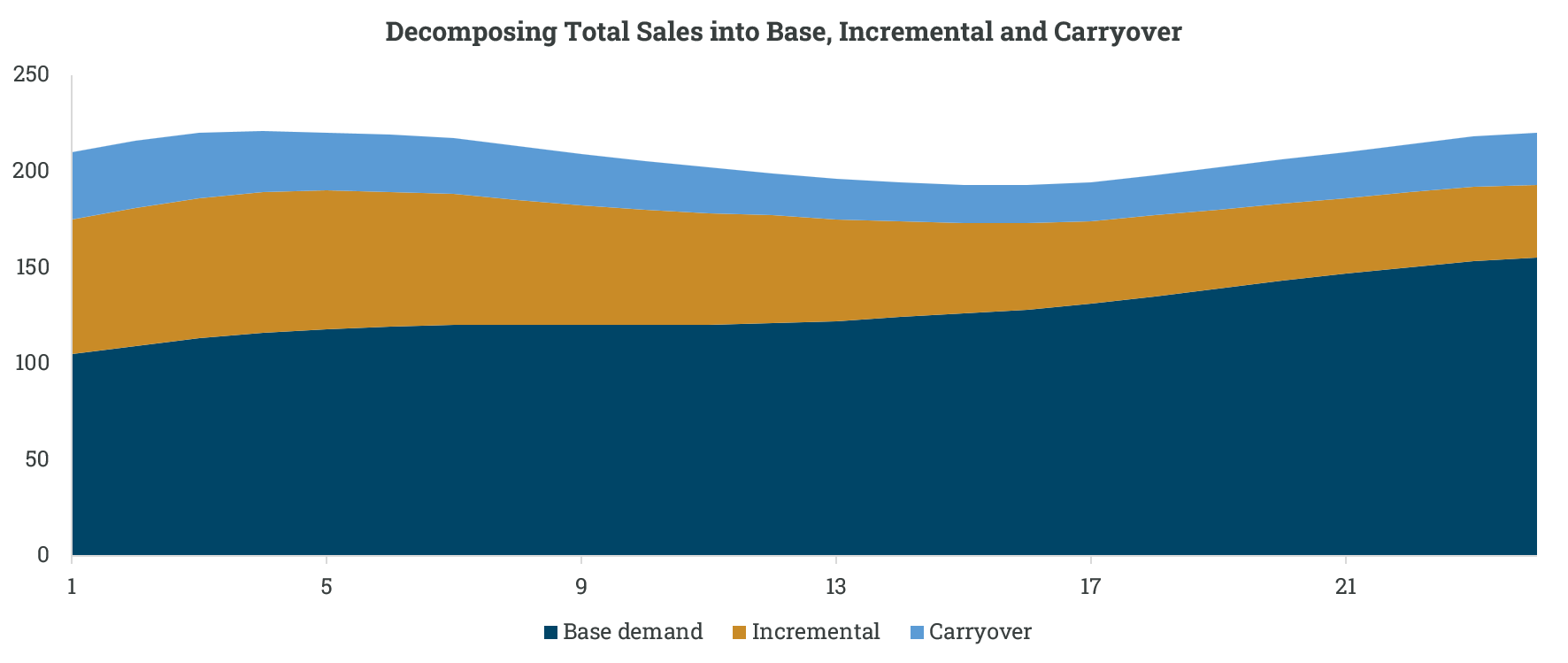
It separates three drivers:
- Base demand from brand equity
- Incremental impact from marketing channels
- Carryover effects from past prescriptions and promotions
This allows teams to measure ROI and simulate budget changes before making decisions.
Why Measuring Channel Impact Is Difficult
The challenge is not data availability. It is how real-world behavior works.
In practice:
- Multiple channels influence the same physician
- Marketing impact is delayed
- Prescribing behavior is habit-driven
Most reporting systems ignore these factors, leading to incorrect attribution.
What MMX Actually Measures
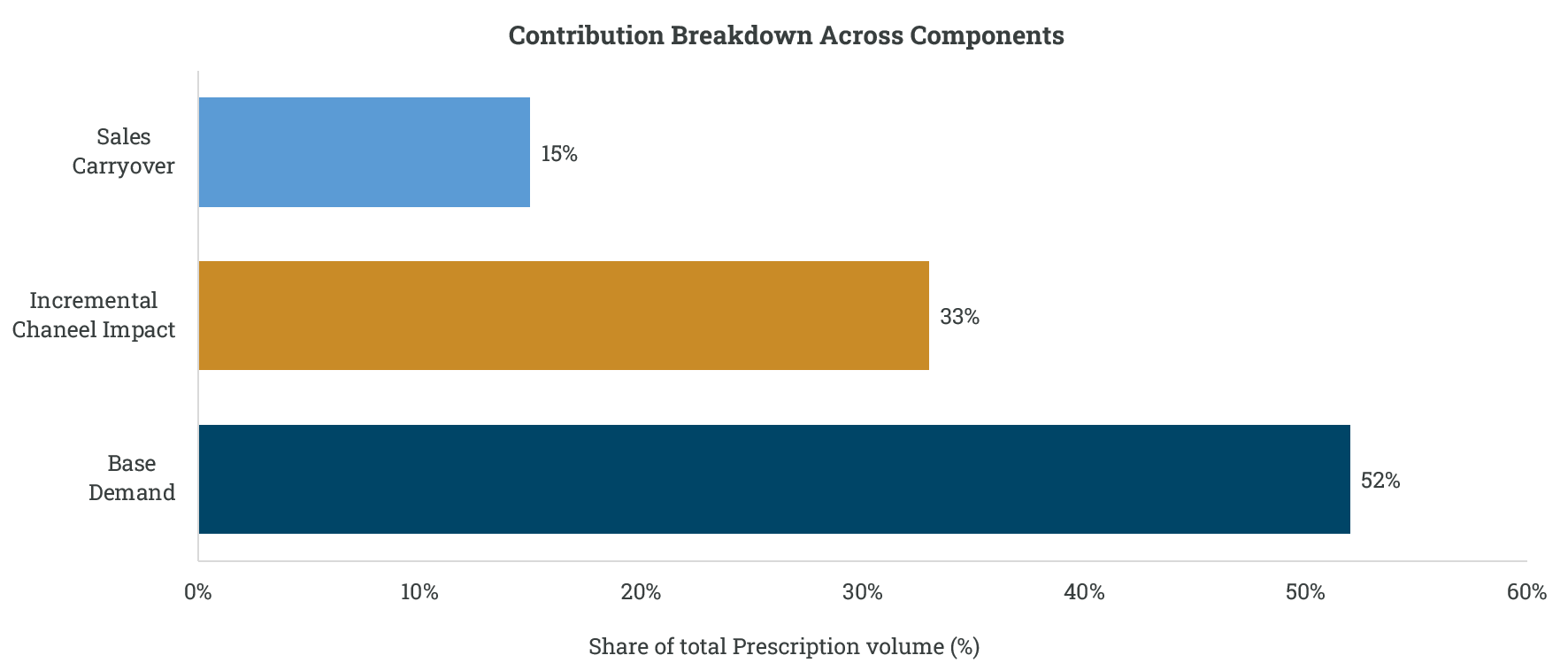
Base Demand
Represents prescriptions that occur without active promotion. Indicates brand strength and long-term equity.
Business impact: Strong base reduces reliance on continuous spend.
Incremental Channel Impact
Measures additional prescriptions generated by each channel.
In practice: Without MMX, high-visibility channels are often overvalued.
Sales Carryover
Captures behavioral momentum from past prescriptions.
Risk: If not separated, it inflates perceived marketing impact.
How Adstocking Captures Delayed Impact
Adstocking models how marketing effects persist over time.
Examples:
- Sales reps influence prescribing over months
- Digital campaigns decay faster
- Congress engagement has medium-term impact
In practice:
Ignoring adstocking leads to underestimating long-term channels and overestimating short-term ones.
Why Diminishing Returns Matter
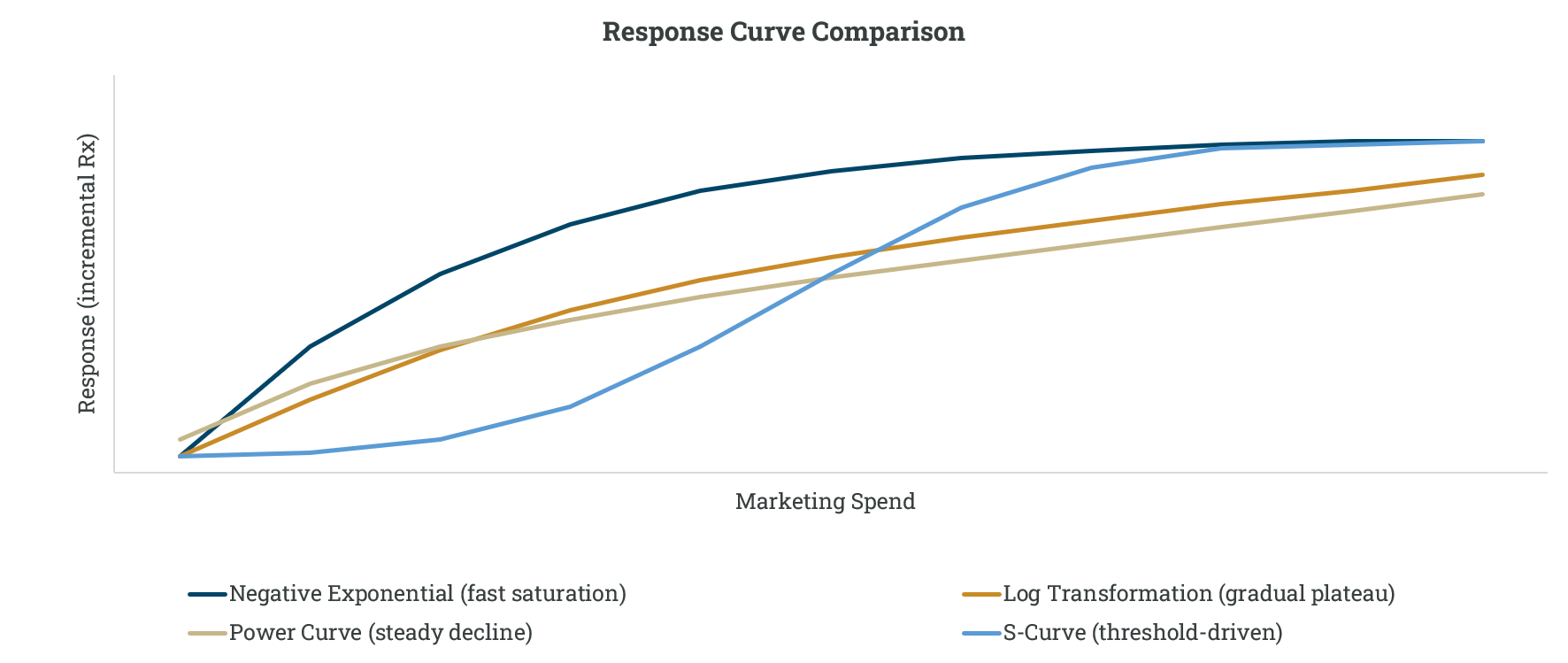
More spend does not always mean more prescriptions.
MMX uses response curves:
- Negative exponential for fast saturation
- Log transformation for gradual plateau
- Power curves for steady decline
- S-curves for threshold-driven impact
In practice:
Wrong assumptions here lead to inefficient budget allocation.
Modelling Approaches: OLS vs Bayesian
Once transformations are in place, the model is estimated through regression. Two approaches dominate pharma MMX today.
OLS
- Easier to interpret – results translate cleanly to commercial language
- Works well when data is clean, time series is adequate, and transformations are well-specified
- The go-to choice for most commercial MMX projects
Bayesian
- Useful when data is limited or noisy – prior knowledge about channel effectiveness can be built into the model
- More flexible in handling uncertainty, but requires careful calibration of priors
- Poorly chosen priors can introduce bias that is hard to detect without rigorous validation
- Probabilistic outputs, while richer, can be harder to communicate to non-technical stakeholders
In practice: Most commercial teams prefer OLS for its clarity and ease of decision-making. Bayesian approaches are gaining traction but work best when the team has strong domain knowledge to specify priors well – and the analytical maturity to interpret probabilistic results.
Why Pharma MMX Runs at the HCP Segment Level
Physicians respond differently based on behavior and context.
Segmentation factors:
- Specialty
- Prescription volume
- Geography
In practice:
Aggregated models hide meaningful differences and lead to poor targeting.
ROI vs MROI: What Actually Drives Decisions
- ROI measures the return generated by already done promotional spend
- MROI measures incremental return from the next unit of spend
In practice:
High ROI channels may already be saturated.
MROI identifies where additional investment creates value.
From Modelling to Budget Optimisation
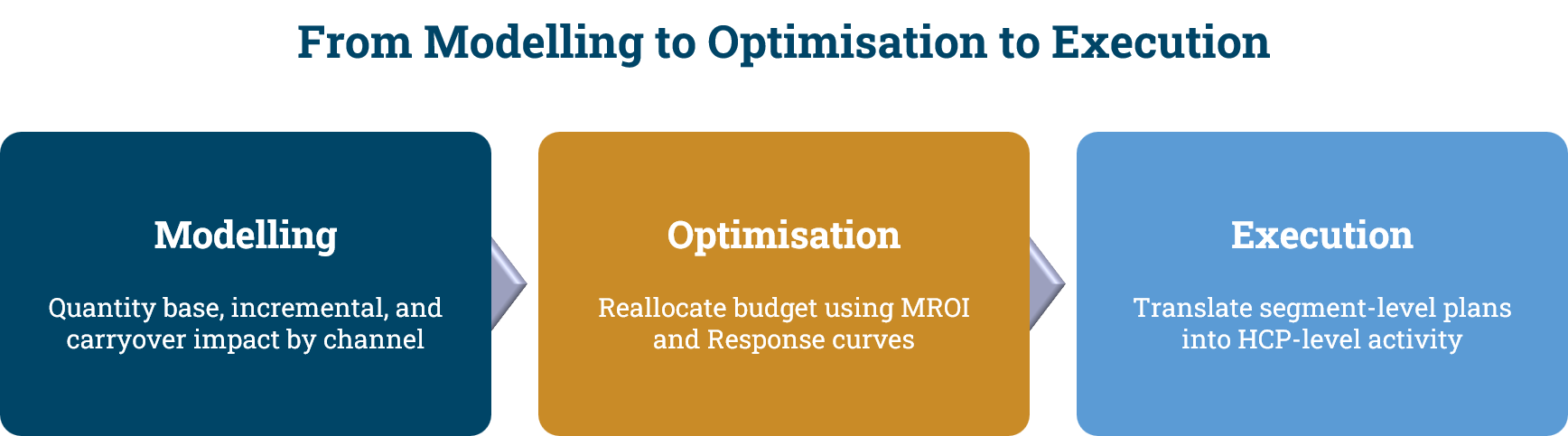
MMX explains what happened. Optimisation defines what to do next.
Common Scenarios
- Budget reallocation – redistribute spend across channels and segments to maximise returns, whether the total budget stays the same or changes
- Sales target planning – work backwards from a target Rx goal to determine how much investment is needed and where
- Unconstrained growth scenarios – remove all budget constraints to reveal the brand’s true commercial ceiling before operational limits are applied
- MROI threshold planning – set a floor on acceptable marginal returns to identify the point where additional spend stops being commercially justified
The Distribution Challenge
Models operate at segment level but execution happens at the HCP level. This creates a practical gap – the optimiser tells you how much activity to direct at a segment, but field teams need to know which specific physicians to call on and how often.
Approaches to bridge this gap:
- Historical allocation – distribute total segment-level activity across HCPs proportionally based on past call patterns
- Average-based distribution – total activity recommended by the optimiser at the channel-segment level is divided equally across all HCPs within that segment, giving each physician an identical allocation
- Forecast-based distribution – use time series forecasting to predict HCP-level activity, useful when promotional patterns are expected to shift
Each approach has trade-offs. The right choice depends on how stable the brand’s promotional patterns are and how much the optimised plan deviates from historical norms.
Portfolio Optimisation
For large pharma enterprises managing multiple brands across therapeutic areas and geographies, optimisation does not have to stop at the brand level.
Portfolio optimisation allocates the total marketing budget across all brands simultaneously – not just within a single brand. This enables:
- Smarter trade-offs when brands compete for shared field force or digital resources
- Identification of which brands deserve incremental investment vs. which are already at saturation
- A unified commercial view that aligns brand-level decisions with enterprise-level objectives
In practice: Brand teams often optimise in silos. Portfolio optimisation forces the conversation about where the next dollar delivers the most value across the entire business – not just within one brand’s budget.
Why Most MMX Programs Fail After Year One
The failure is operational, not analytical.
Common issues are:
- Rebuilding data pipelines
- Losing historical context
- Limited accessibility
Business impact includes:
- Delays
- Low trust
- Poor adoption
What Works in Practice
To scale MMX effectively:
- Standardize data pipelines
- Reuse model configurations
- Maintain version history
- Enable access for commercial teams
The goal is faster and repeatable decision-making.
Bridging the Gap Between Analytics and Commercial Teams
The biggest barrier is usability.
In practice:
- Insights stay within analytics teams
- Commercial teams struggle to interpret outputs
What works:
- Business-friendly outputs
- Scenario-based insights
- Continuous access
Conclusion: What Changes in Practice
MMX shifts decision-making from intuition to evidence.
Teams that succeed:
- Measure channel impact rigorously
- Use MROI for planning
- Embed MMX into regular planning cycles
The advantage is not data availability. It is consistent decision-making using that data.
How Chryselys Helps Operationalise Market Mix Modelling
Most organisations do not struggle with building a model. They struggle with sustaining it.
Chryselys focuses on making MMX usable in day-to-day decision-making by:
- Standardizing data ingestion and model workflows
- Preserving historical analyses for comparison
- Enabling scenario simulation for budget planning
- Translating complex outputs into business-ready insights
This allows commercial teams to move from one-time analysis to continuous optimization, without rebuilding the process for each cycle.
FAQs
1. When should a pharma team rely on MMX instead of attribution models or dashboards?
MMX is more reliable when multiple channels influence the same physician over time and when delayed effects matter. Attribution models work best in digital-first environments with clear user journeys, which is rarely the case in pharma. MMX accounts for carryover effects, diminishing returns, and base demand, making it better suited for strategic budget allocation. In practice, teams use dashboards for monitoring and MMX for decision-making. The two are complementary, but MMX is the only approach that quantifies channel-level contribution with statistical rigour – accounting for carryover, saturation, and base demand simultaneously
2. What data readiness is required to implement MMX effectively in pharma?
MMX requires consistent time-series data across prescriptions, promotional activity, and external factors. At a minimum, teams need monthly or weekly data at the HCP, along with channel activity such as sales calls, digital impressions, and event participation. Data gaps are common, but the bigger issue is inconsistency across sources. In practice, most delays come from data alignment rather than modelling. Teams that standardise definitions and maintain structured pipelines see faster and more reliable outcomes.
3. What are the most common mistakes that lead to incorrect MMX results?
The biggest mistakes come from mis-specifying carryover effects and response curves. Ignoring adstocking leads to undervaluing long-term channels, while incorrect transformation functions distort diminishing returns. Another common issue is failing to separate baseline sales from promotional impact, which inflates ROI. Multicollinearity between simultaneously deployed channels – such as sales force and digital – is also frequently overlooked, leading to unstable or misleading coefficient estimates. Insufficient data history compounds all of these issues, as reliable adstock and saturation estimation requires at least two to three years of consistent data. In practice, these errors do not just affect model accuracy. They directly impact budget allocation decisions, often reinforcing inefficient spend patterns instead of correcting them.
4. How does MMX influence real budget decisions at the brand level?
MMX shifts decisions from historical allocation to evidence-based optimisation. Instead of asking which channel performed best last year, teams focus on where the next unit of spend will generate the highest return using MROI. This often leads to reducing spend in saturated channels and increasing investment in underutilised ones. In practice, the impact is not just better ROI. Teams gain confidence to challenge legacy spending patterns and justify decisions to leadership with data.
5. How is MMX evolving with AI and changing pharma marketing channels?
MMX is moving from static annual models to continuous, platform-driven systems. AI is improving how teams interact with models by translating outputs into business language and enabling faster scenario testing. At the same time, new channels such as omnichannel engagement and real-time digital interactions are increasing model complexity. In practice, the focus is shifting from building better models to making them more usable, accessible, and integrated into everyday decision-making.