

A mid-size pharma brand spends months building its HCP target list. The commercial analytics team pulls prescriber decile data, ranks physicians by historical volume, and hands the list to the field. Six months later, engagement rates are under 5%, and half the reps report calling on physicians who haven’t seen a relevant patient in over a quarter.
This is not an edge case. It is the default outcome when targeting relies on backward-looking volume data disconnected from where patients actually are in their care journey.
The fix is not more data. It is different data, used differently. Patient journey analytics, built on longitudinal claims, lab results, and EHR signals, can show commercial teams which physicians are about to face a prescribing decision, not just which ones made one last year. That distinction changes everything: who gets a rep visit, what message they receive, and whether the engagement feels clinically relevant or like noise.
The Problem with Decile-Based Targeting
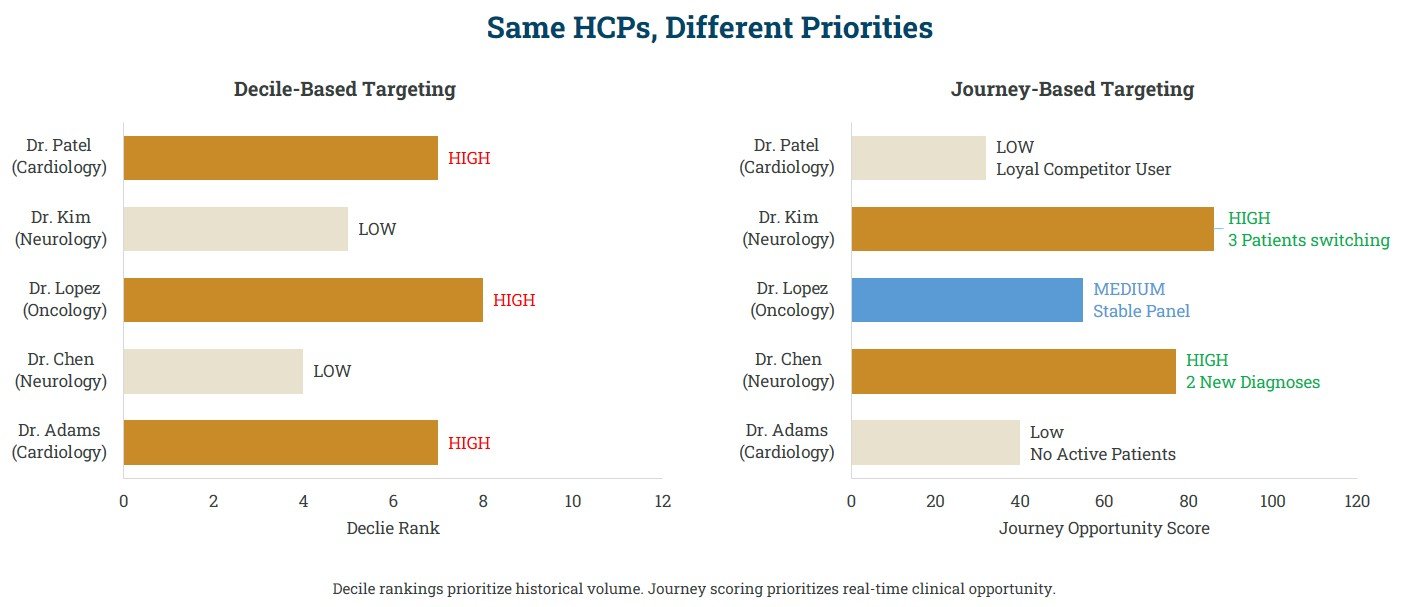
Decile rankings have been the default HCP segmentation method for decades. Rank physicians 1 to 10 by category TRx volume. Focus the field force on high deciles. Push digital to the rest. It is simple to operationalize, and that simplicity is exactly its weakness.
A decile-9 cardiologist who writes 80% of prescriptions for a competitor and has never switched a patient is not a high-opportunity target. A decile-5 neurologist with three newly diagnosed patients this month, two of whom failed first-line therapy, is. Volume rankings cannot see this difference. Patient journey data can.
The business impact is measurable. Industry data shows that brands using multi-source propensity scoring, incorporating claims, engagement history, and practice-level signals, achieved HCP targeting hit rates above 70%. That is a 15-point improvement over volume-only lists, and every 10-point gain in targeting precision reduced cost-per-incremental-script by roughly one-third.
When 69% of pharma companies already cite ROI measurement as the top challenge in digital HCP engagement, continuing to target off static volume data is an expensive form of guessing.
What Patient Journey Data Actually Reveals
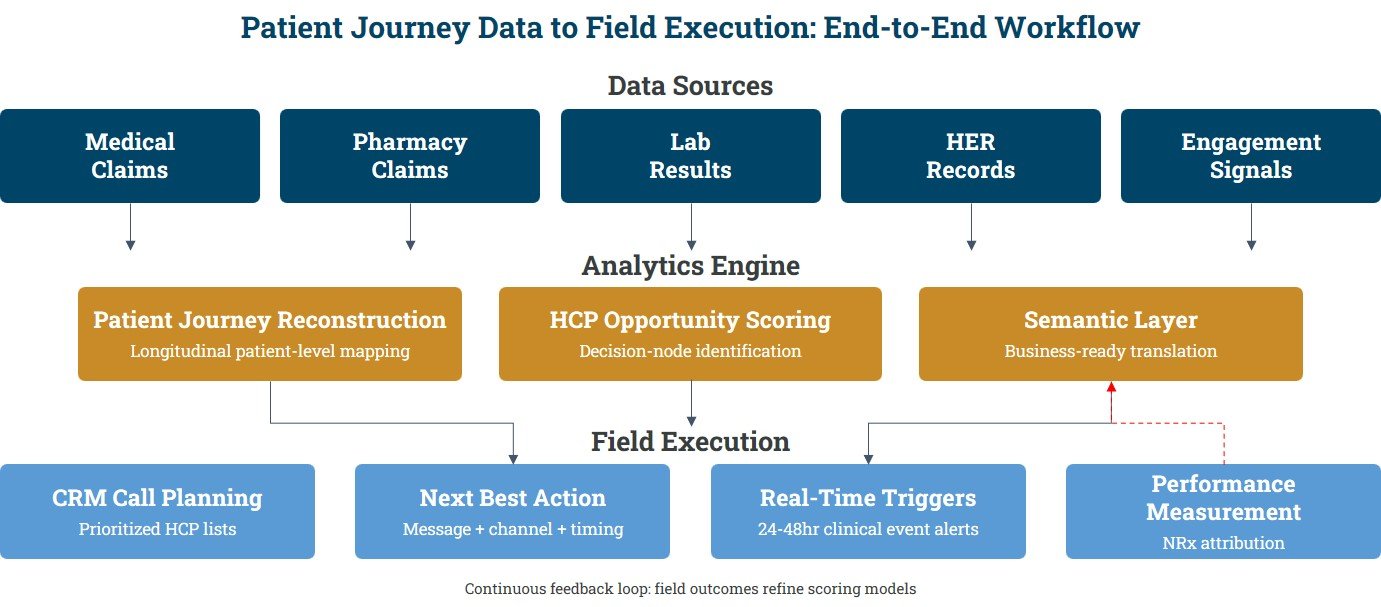
Patient journey analytics reconstructs longitudinal, de-identified patient-level data, including medical and pharmacy claims, lab results, EHR records, and increasingly clinical notes, into a continuous trajectory from symptom onset through diagnosis, treatment, switching, and adherence.
For commercial analytics teams, this is not an academic exercise. It answers operational questions that decile data cannot.
Which Physicians Are Seeing Relevant Patients Right Now
Claims data shows which HCPs treated a condition historically. Journey data shows which ones have active patients approaching a treatment decision point. A physician who ordered a confirmatory lab test last week is more valuable than one who wrote a prescription six months ago. Lab data, in particular, has become the most real-time signal available. Some commercial teams now trigger HCP engagement within 24 to 48 hours of a relevant test order, putting their message in front of a physician precisely when they are weighing treatment options.
Where Patients Drop Off or Get Stuck
Journey mapping exposes the friction points: long gaps between diagnosis and treatment initiation, high rates of therapy abandonment after prior authorization denials, or patients cycling through three specialists before reaching the right treater. Each of these drop-off points identifies an HCP who needs different support, whether that is access assistance, peer education, or clinical data on a specific patient subgroup.
Who Influences the Decision Before the Prescription
Most HCP targeting focuses on the treating specialist. But patient journey data often reveals that a referring PCP or a diagnosing specialist determines where the patient ends up. In rare disease, where diagnostic odysseys span years and multiple providers, identifying the upstream referral chain can be more commercially significant than targeting the eventual prescriber.
From Insight to Field Execution: Where Most Teams Stall
The hardest part of patient journey-based targeting is not building the analytics. It is getting the output into a rep’s hands in a form they can act on.
A common failure pattern: the commercial analytics team builds a sophisticated journey model, identifies high-opportunity HCPs based on active patient flow, and presents the findings in a quarterly business review. The insights sit in a slide deck. Reps continue working off the same call list they had before.
Operationalizing journey-based targeting requires three things most teams underestimate.
CRM Integration, Not Parallel Reporting
Journey-based HCP scores and triggers must feed directly into call planning tools and next-best-action engines. If a rep has to open a separate dashboard to see journey insights, adoption drops to near zero. The output should surface as a prioritized call list, with the right message, for the right HCP, at the right time, inside the system the rep already uses every morning.
Trigger-Based Cadence, Not Quarterly Refreshes
A static target list updated every quarter cannot keep pace with patient flow. HCPs move between opportunity windows quickly. One pharma team running real-time lab and claims triggers in a rare disease indication more than doubled HCP engagement rates, from 14% to 32%, because they reached physicians when a clinical event was fresh, not months after the fact.
Explainable Scores, Not Black Boxes
A propensity score of 73% means nothing to a field rep or a compliance reviewer without a breakdown. What drives the score? Is it recent patient volume, engagement history, payer access at the HCP’s primary site, peer influence, or early adoption patterns? Transparent scoring builds field trust and satisfies the explainability requirements that regulators, including the EU AI Act enforced since 2025, now demand of AI-driven healthcare decisions.
The Data Quality Problem Nobody Talks About
Patient journey analytics is only as good as the underlying data. And here is what most vendor marketing will not say: a single anonymized patient-level data (APLD) source almost always carries significant biases.
One vendor may have strong coverage of commercial payer lives but minimal Medicare visibility. Another may over-represent urban academic medical centers and under-represent community practices. Geographic coverage gaps mean entire patient populations vanish from the journey map.
The practical consequence is that commercial teams build HCP target lists that systematically miss physicians in certain regions, practice settings, or payer environments. For rare disease and oncology, where every patient counts, these blind spots can mean the difference between a successful launch and a missed market.
The solution is data stacking: harmonizing APLD from multiple vendors, normalizing patient tokens, and reconciling overlapping and non-overlapping coverage to create a more complete picture. This is operationally complex, and many data vendors actively discourage it through proprietary token schemes or contractual restrictions. But the teams that invest in multi-vendor data integration consistently report sharper targeting and fewer missed HCPs.
Compliance as a Competitive Advantage
Patient journey-based targeting, done correctly, is actually easier to defend from a compliance standpoint than traditional approaches.
When an HCP receives an engagement because a relevant clinical event occurred in their patient panel, the touchpoint has clear clinical rationale. Compare that to a rep visit triggered solely because the physician’s decile ranking is high enough. The first is defensible. The second is promotional inertia.
With the EU AI Act classifying AI systems used in healthcare as high-risk, and the FDA expected to issue AI transparency guidance by late 2026, the bar for explainability is rising fast. Teams using patient journey data as the foundation for HCP scoring can document exactly why a particular physician was prioritized: patient volume in the relevant condition, stage of treatment, lab indicators, payer access at their practice site. That audit trail is a compliance asset, not a burden.
What This Looks Like in Practice
Consider a specialty pharma company preparing to launch a therapy in a rare disease indication. Traditional targeting would pull retrospective claims data, rank HCPs by historical diagnosis or treatment volume, and build a static list. But rare diseases have high misdiagnosis rates and complex referral patterns. The HCPs who diagnosed patients last year may not be the ones seeing undiagnosed patients today.
By mapping the full patient journey, from initial symptom presentation through referral chains, diagnostic testing, and eventual treatment, the commercial team can identify three distinct HCP segments that a volume-based approach would miss: the referring PCPs who initiate the diagnostic workup, the specialists ordering confirmatory tests, and the treating physicians who ultimately prescribe. Each segment requires a different message, a different channel, and a different cadence.
One team that deployed this approach using real-time lab triggers and claims signals in a rare disease indication saw Rx lift within six months, outperforming competitors in what was considered a crowded space. The key was not better data alone. It was faster, more precise activation of that data at the point of clinical decision-making.
The Shift Ahead
Three developments are reshaping how patient journey data will be used for HCP targeting over the next two to three years.
First, agentic AI is moving from pilot to production. Instead of analysts querying journey data and building reports, AI systems will autonomously identify targeting opportunities, generate insights, and recommend actions, provided the underlying data infrastructure includes a pharma-native semantic layer that translates clinical complexity into business-ready concepts.
Second, lab data is becoming a primary targeting trigger, not a supplementary signal. For therapeutic areas where a test result directly precedes a treatment decision, lab-triggered engagement within 24 to 48 hours will become the standard, not the exception.
Third, unified HCP and patient journey orchestration is replacing siloed commercial functions. The brands gaining ground are those that treat HCP targeting, patient engagement, data infrastructure, and field execution as one connected system rather than four separate workstreams.
Closing Thought
Patient journey data does not replace clinical judgment or commercial intuition. It sharpens both. The teams getting the most from it are not the ones with the most sophisticated models. They are the ones who have closed the gap between analytical insight and field execution, who refresh targeting continuously instead of quarterly, and who measure success by new patient starts rather than impressions delivered.
The bar for HCP engagement has moved permanently. Eighty percent of physicians still report receiving generic, impersonal communications from pharma. The commercial teams that use patient journey data to change that will not just target better. They will earn clinical credibility that competitors relying on volume-based outreach cannot match.
FAQs
1. How does patient journey data change HCP targeting compared to decile-based approaches?
Patient journey data shifts targeting from historical prescribing volume to real-time clinical opportunity. Instead of ranking HCPs by past TRx, journey analytics identifies which physicians have active patients approaching a treatment decision, such as a therapy switch, new diagnosis, or adherence failure. This means field teams prioritize HCPs based on current patient flow and clinical context, not static rankings. Brands using multi-source journey-based propensity scores have reported targeting precision improvements of 15 points or more over volume-only lists, with measurable reductions in cost-per-incremental-script.
2. What data sources are needed to build a journey-based HCP targeting model?
A robust model integrates anonymized patient-level data (APLD) from medical and pharmacy claims, lab results, EHR records, and prescription transaction data. Lab data is especially valuable because it provides near-real-time clinical signals, such as test orders that precede a treatment decision. Most effective implementations stack data from multiple vendors to correct for geographic, payer, and channel biases inherent in any single source. The data must be harmonized through a semantic layer that translates clinical codes into business-ready concepts like treatment line, time-to-diagnosis, and new-to-brand prescriptions.
3. How do you measure the ROI of patient journey-driven HCP targeting?
ROI measurement should connect targeting inputs to downstream prescribing outcomes. The primary metric is new-to-brand prescriptions (NRx) attributed to journey-triggered HCP engagements, tracked via multi-touch attribution models. Supporting KPIs include HCP engagement rate (meaningful interactions, not impressions), cost-per-incremental-script compared to decile-based campaigns, and time-to-first-prescription after targeted engagement. Teams that shifted from quarterly list refreshes to real-time journey triggers have reported HCP engagement rate increases from 14% to over 30%, with corresponding Rx lift within six months.
4. Why do single-vendor APLD datasets create blind spots in HCP targeting?
Every APLD vendor has structural coverage biases. One may over-represent commercial payer lives and under-represent Medicare populations. Another may have strong urban academic medical center data but limited rural or community practice coverage. These gaps mean patient journey maps built on a single source systematically miss physicians in certain geographies, practice settings, or payer environments. Data stacking, harmonizing APLD from multiple vendors, corrects these biases by reconciling overlapping and non-overlapping coverage to create a more complete and accurate view of patient flow and HCP opportunity.
5. How can pharma companies make AI-driven HCP scoring models compliant and explainable?
Compliant AI scoring requires transparent driver breakdowns for every HCP score. Rather than a black-box propensity number, the model should show the weighted contribution of each factor: recent patient volume, engagement history, payer access at the practice site, peer influence, and adoption patterns. The EU AI Act, enforced since 2025, classifies healthcare AI as high-risk and mandates documented bias audits, human-in-the-loop review for final targeting decisions, and clear explainability. Using patient journey data as the scoring foundation provides the clinical rationale that makes each targeting decision auditable and defensible.
How Chryselys Can Help with Patient Journey-Based HCP Targeting
The gap between patient journey insight and commercial execution is where most pharma teams lose value. Chryselys works at this intersection, combining deep APLD expertise with operational analytics that connect directly to field workflows.
Chryselys’ Patient Analytics Platform unifies claims, EMR, lab, and formulary data into a single, dynamic view of the patient journey, built for commercial and medical teams who need cohort-specific insights without months of data wrangling. For teams dealing with the blind spots created by single-vendor data, Superstack (Data Stacking) harmonizes APLD from multiple vendors to eliminate geographic and payer biases that distort HCP targeting.
On the execution side, Chryselys’ Next Best Action (NBA) engine translates journey-based HCP scores into prioritized, explainable actions, delivered inside the CRM systems reps already use. Combined with Field Force Excellence capabilities for territory alignment and call planning, the result is a connected system where patient journey insights flow directly into commercial operations rather than sitting in a slide deck.
Learn more at Commercial Analytics