

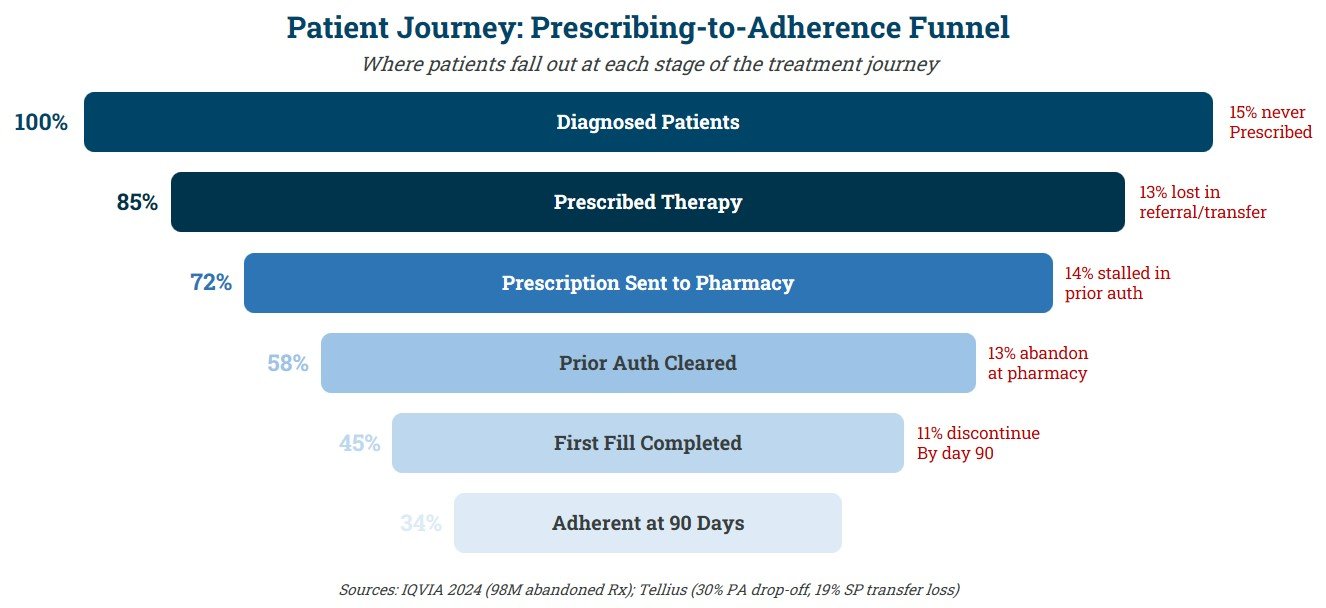
A specialty brand launches with strong clinical data, solid payer coverage, and a well-trained field force. Six months in, 30% of patients prescribed the therapy never fill their first prescription. Another 25% drop off within 90 days. The brand team has a patient journey map on a slide somewhere. It shows neat boxes: diagnosis, treatment initiation, adherence, outcomes. None of those boxes explain why patients are disappearing.
This is the reality for most pharma brands. Patient journey mapping has become a standard deliverable in commercial planning. But for many organizations, the map is where the work ends. It gets presented at a brand planning meeting, pinned to a shared drive, and rarely revisited. The gap between what companies think is happening and what is actually happening in claims data, pharmacy records, and HCP conversations is significant.
The Cost of Getting Patient Journeys Wrong
In 2023 alone, 98 million new therapy prescriptions were abandoned in the United States, according to IQVIA. Of those, 44 million were abandoned even when costs were under $10, including zero-cost prescriptions. Cost is the default explanation for abandonment, but nearly half of all abandoned scripts had minimal or no financial barrier. Something else is breaking.
Non-adherence contributes to roughly 125,000 avoidable deaths annually in the U.S. and more than $500 billion in downstream healthcare costs. For individual brands, a specialty product with 50,000 annual prescriptions and 25% primary non-adherence loses patients before they ever start therapy. At $8,000 average net revenue per patient per year, that is $100 million in annual revenue at risk before secondary discontinuation even enters the picture.
Why Most Patient Journey Maps Fail to Drive Action
The Static Map Problem
Traditional journey mapping is a one-time exercise. A cross-functional team meets for a workshop, produces a visual, and moves on. But patient behaviour shifts constantly. Formulary changes, competitor entries, and new prior authorization requirements reshape how patients move through the system. The industry benchmark for building a bespoke patient journey is seven to nine weeks per therapeutic area. By the time the map is complete, the landscape it describes has already changed.
Claims Data Tells Half the Story
Most journey mapping relies heavily on claims and prescription data. These sources track what happened but cannot explain why. Claims miss caregiver influence, side-effect anxiety, specialty pharmacy confusion, and the emotional burden of navigating a complex system. When a family member overrides a physician recommendation, that signal exists nowhere in the claims record.
Siloed Ownership
Journey maps often live within the insights team. They inform a brand strategy deck but rarely connect to field force operations, market access decisions, or patient support programs. Without cross-functional ownership, maps become intellectual exercises. The commercial team does not act on them because the insights are not translated into specific interventions at specific touchpoints.
What Actually Works: From Maps to Continuous Intelligence
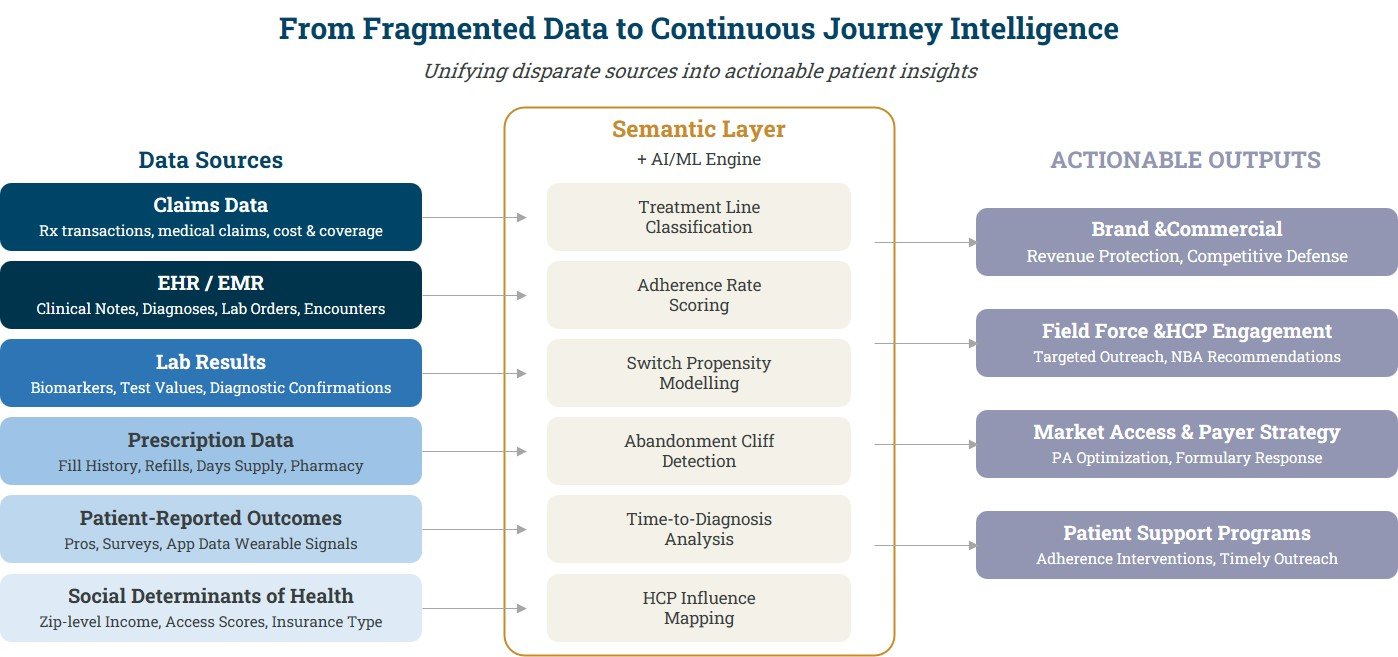
The shift across the industry is from periodic, descriptive mapping to continuous journey intelligence: always-on, AI-driven analysis that monitors treatment patterns, flags anomalies, and delivers insights without waiting for someone to ask.
Layering Data Sources
Effective journey intelligence combines claims, EHR, lab results, prescription transactions, patient-reported outcomes, and social determinants of health. The goal is to understand the clinical, financial, and behavioral signals that precede a therapy switch or drop-off. Companies investing in this approach report 70 to 85% reduction in time-to-insight and $5 to $15 million in revenue protected per brand annually.
The Semantic Layer Nobody Talks About
Patient journey data spans claims, EHR, lab, prescription, and social determinant data across different coding systems. A semantic layer translates this complexity into business-friendly concepts like “treatment line,” “adherence rate,” and “new-to-brand prescription” that brand managers can query directly. Without this translation layer, even sophisticated AI tools produce outputs that commercial teams cannot use.
Identifying the Moments That Matter
Not every touchpoint carries equal weight. Proactive outreach within the first 48 hours after a prescription is written is the single highest-leverage intervention for preventing primary non-adherence. Yet most companies lack a systematic process for this window. Similarly, roughly 19% of patients transferred between specialty pharmacies are never re-identified, breaking continuity entirely. These are specific, addressable failure points.
Moving from Descriptive to Predictive
The most advanced organizations are moving beyond describing what happened to predicting what will happen next. Predictive journey models use sequence-based AI to forecast which patients are likely to switch, discontinue, or abandon therapy within the next 30 to 90 days. This treats patient treatment sequences the way language models treat text: each therapy and event is a “token,” and the model predicts the next one. Platforms built around patient journey prediction are compressing months of manual analysis into real-time scoring, enabling intervention before the drop-off rather than after.
Equally important is identifying patients who should be on therapy but are not. Many patients with rare or misdiagnosed conditions never reach the right treatment because diagnostic signals are hidden in fragmented records. Advanced patient finder approaches combine clinician-authored phenotyping rules with machine learning to surface undiagnosed patients even without a definitive diagnosis code.
What Most Teams Get Wrong
The most common mistake is treating the map as the final output rather than the starting input. A map without operationalization is an expensive artifact. The second mistake is over-indexing on cost as the primary abandonment driver. When nearly half of abandoned prescriptions have minimal cost barriers, the real drivers are confusion, caregiver override, side-effect anxiety, and pharmacy channel complexity. Third, many teams build maps around a single patient archetype. Younger patients gravitate toward virtual consults and AI chat. Older adults prefer consolidated, readable information. A single journey map cannot serve both populations.
What Changes Next
Agentic AI, where systems perform analysis autonomously rather than assisting analysts, is being deployed by multiple major vendors for continuous monitoring and proactive alerting. Digital twins of patient populations are emerging for stress-testing commercial strategies before launch. Direct-to-patient models are expanding, giving manufacturers more visibility into the post-prescription experience. And social determinants of health data are moving from pilot to standard practice in journey maps, helping explain disparities that purely clinical data cannot.
The pharma organizations that will win on patient retention are not the ones with the best journey maps. They are the ones that connect journey intelligence to daily operational decisions across commercial, medical, and access teams. The map was never the point. The action it enables is.
FAQs
1. Why do patients abandon prescriptions even when there is no cost barrier?
Cost is only one factor. Patients abandon zero-cost prescriptions due to confusion about specialty pharmacy processes, anxiety about side effects they were not prepared for, caregiver influence that overrides physician recommendations, and prior authorization delays. Journey analytics that track the full prescribing-to-filling funnel can isolate which factors dominate for a given brand, enabling targeted interventions rather than blanket copay support.
2. How does AI compress patient journey mapping timelines in pharma?
Traditional journey mapping takes seven to nine weeks per therapeutic area through manual data assembly and cross-functional workshops. AI-powered approaches ingest claims, EHR, lab, and prescription data continuously, apply sequence-based models to identify treatment patterns, and deliver insights through a semantic layer that commercial teams can query directly. This reduces time-to-insight by 70 to 85% and enables always-on monitoring rather than periodic snapshots.
3. What is the measurable ROI of patient journey analytics?
Pharma companies using continuous journey intelligence report $5 to $15 million in revenue protected per brand annually through earlier detection of competitive switching, access barriers, and adherence drop-offs. AI-optimized targeting based on journey signals shows 10 to 15% improvement in new-to-brand prescriptions versus traditional decile approaches. Typical payback is six to nine months.
4. How should journey mapping inform market access strategy?
Journey analytics quantify where patients fall out of the prescribing-to-filling funnel due to prior authorization, step therapy edits, and formulary tier changes. By identifying “abandonment cliffs” and measuring lag between formulary changes and real-world impact, market access teams can prioritize payer negotiations, redesign hub workflows, and target interventions at exact points of highest patient vulnerability.
5. Why do most pharma patient journey maps fail to drive commercial action?
Three structural problems cause this. Maps are built as one-time artifacts that become stale as markets shift. They rely primarily on claims data, which tracks what happened but not why. And they are owned by insights teams without connection to field force operations, patient support programs, or market access workflows. Effective journey intelligence requires continuous data feeds, layered data sources, and cross-functional integration that turns insights into specific actions.
How Chryselys Can Help with Patient Journey Mapping
The gap between having a patient journey map and using it to protect revenue is where most pharma organizations stall. Chryselys works at this intersection, combining pharma domain expertise with scalable analytics to turn fragmented patient data into operational intelligence.
Through its Patient Analytics Platform, Chryselys unifies claims, EHR, lab, and formulary data into a single dynamic view. For teams moving to forward-looking intelligence, Patient Journey Prediction uses sequence-based AI to forecast switching and adherence risks at the individual patient level. For brands facing diagnostic delays, Patient Finder surfaces undiagnosed patients using hybrid ML and clinician-authored phenotyping. The focus is practical: turning complex data into signals that commercial, medical, and access teams can act on.