

The problem: Expensive decisions made with partial visibility
Consider a familiar challenge in the pharma strategy. A late-stage oncology asset delivers strong Phase II results, giving leadership confidence to advance into an ambitious Phase III design and prepare for launch.
Then the market context changes. Six months later, a competitor releases unexpected data with a stronger endpoint, a narrower but more defensible patient segment, and a regulatory response that challenges the assumptions behind the original strategy.
As a result, a plan that once appeared well positioned now looks overextended. The trial design requires re-evaluation, and the launch strategy carries more exposure than anticipated.
For many pharma organizations, this is not an exception. It is a recurring strategic challenge.
Despite significant investment in analytics, high-value decisions are still often made with fragmented competitive visibility. The issue is no longer access to data; it is the ability to translate external signals into timely, forward-looking decisions.
This is where competitive intelligence, or CI, is becoming a critical capability for more confident, better-informed decision-making.
Why it happens: When CI remains downstream
In many pharma organizations, competitive intelligence still enters the process too late. Instead of shaping strategic choices upfront, CI is often used to document market activity after key decisions have already been made.
Teams monitor competitor pipelines, summarize earnings calls, and circulate updates after major events. These activities are valuable, but on their own they rarely change the direction of a portfolio, trial, or launch strategy.
The result is a set of execution gaps that limit the impact of intelligence on decision-making:
1. Intelligence arrives after the decision window has closed
Strategy teams often move faster than traditional intelligence cycles. By the time insights are packaged and shared, the critical go/no-go, design, or investment decision may already be in motion.
2. Signals remain fragmented across functions
Clinical, regulatory, and commercial signals often sit in separate systems and are interpreted by different teams. Without a unified narrative, organizations miss the patterns that connect competitor’s behavior to future market outcomes.
3. Updates stop short of interpretation
Many CI outputs describe what competitors have done but provide limited perspective on why those moves matter. The real value comes from connecting actions to intent, implications, and the decisions leaders need to make next.
When these gaps persist, organizations can appear highly informed while still making decisions with limited strategic advantage. The outcome is high activity, but low impact.
Business impact: Missed launches, misallocated capital, avoidable risk
The consequences of weak CI extend far beyond missed updates or delayed reporting.
They show up in the decisions that shape portfolio performance, launch success, and long-term growth.
Consider the challenge facing many pharmaceutical organizations today:
- Roughly half of launches fail to meet expectations
- Many clinically differentiated products still struggle commercially
- Hundreds of billions of dollars in revenue face pressure from upcoming patent expirations
These outcomes are often attributed to market conditions.
The costliest mistakes rarely stem from a lack of data. They occur when organizations misread the implications of emerging signals.
Common examples include:
- Advancing an indication that competitors have already strengthened their position in
- Designing trials that fail to create meaningful differentiation
- Launching into a market that has already begun to shift
- Underestimating competitor market access or pricing strategies
CI cannot eliminate uncertainty. However, it can significantly improve the quality and timing of strategic decisions.
The difference is not eliminating risk altogether. It is reducing the likelihood of avoidable mistakes.
What has changed: CI is now an enterprise decision system
The leading shift is simple but important.
Leading organizations are no longer treating competitive intelligence as a downstream reporting process. They are embedding it directly into decision-making
Rather than helping teams understand decisions that have already been made, CI is increasingly helping shape the decisions themselves.
This changes how intelligence is applied across the pharmaceutical lifecycle:
In clinical development
CI supports:
- Go/no-go decisions
- Endpoint selection
- Trial design optimization
By analyzing competitor protocols, enrollment trends and development outcomes, organizations gain a clearer understanding of where differentiation opportunities and risks exist.
In launch planning
CI helps teams:
- Assess market readiness
- Evaluate competitor positioning
- Track stakeholder behaviour shifts
- Inform investment decisions
The objective is to determine where to compete, how to position assets, and where resources can create the greatest impact.
In lifecycle management
As products approach loss of exclusivity (LoE), intelligence helps organizations monitor:
- Biosimilar and generic activity
- Pricing dynamics
- Access and reimbursement changes
- Emerging competitive threats
The goal is to anticipate disruption early enough to respond strategically rather than reactively.
In portfolio allocation
Competitive intelligence helps identify:
- Areas of unmet need
- Crowded competitive spaces
- Emerging opportunities
- Markets with stronger probability of success
Across each of these applications, the common theme remains the same.
The primary purpose of CI is no longer information delivery. It is decision support.
The patent cliff is forcing a reset
The scale of upcoming patent expirations is changing how companies think about CI.
As blockbuster therapies approach LoE, organizations face growing pressure to protect revenue and identify new sources of business.
In this environment, leadership teams need answers to critical questions:
- When are generics or biosimilars likely to enter the market?
- Which competitors are preparing alternative therapies?
- How will payer behavior evolve?
- Where can innovation extend product value?
Without timely intelligence, these questions may often be addressed a bit late. With timely CI, organizations can act earlier by:
- Adjusting commercialization strategies
- Accelerating lifecycle initiatives
- Prioritizing defensive innovation
- Redirecting investments toward higher-value opportunities
The difference can have significant implications for both revenue protection and future growth.
Launch war-gaming is becoming standard practice
One of the clearest examples of intelligence-driven decision-making can be found in launch planning.
More organizations are adopting structured war-gaming exercises to prepare competitive responses before launch.
These exercises combine available market evidence with strategic scenario planning to explore how competitors may react under different conditions.
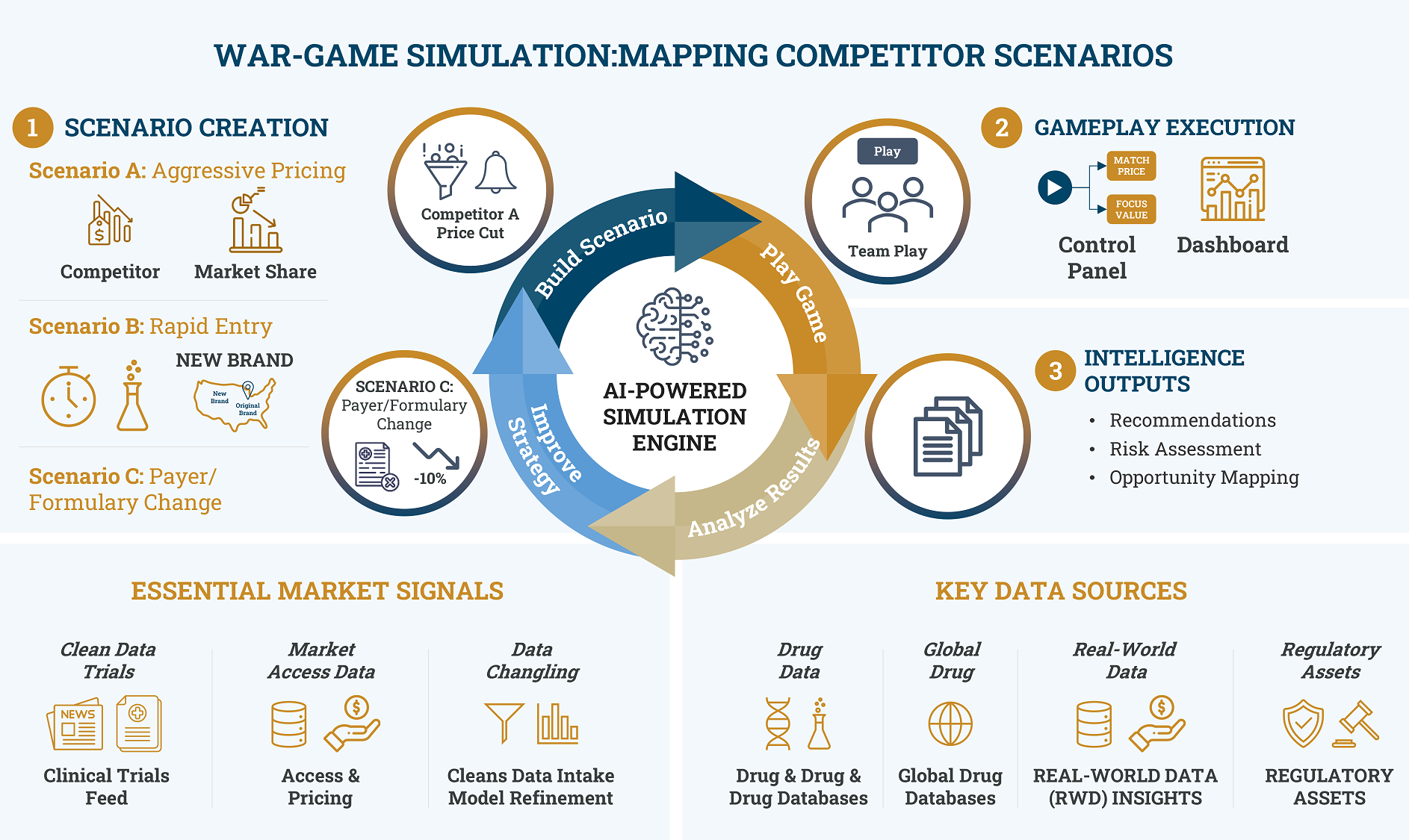
The purpose is not to predict the future with certainty but to understand how a strategy performs when key assumptions are challenged.
Through this process, teams often uncover vulnerabilities such as:
- A positioning strategy that fails under price pressure
- A field force model that cannot respond to competitor access tactics
- A segmentation approach that ignores emerging patient subsets
The value of war-gaming lies in preparation and organizations that understand potential competitive responses before launch are often better positioned to adapt when market conditions change
The real advantage comes from connecting signals and data integration
Many organizations continue to believe that better CI comes from more data sources.
In practice, leading teams are discovering that the real advantage comes from integration, not volume.
High-performing CI teams typically combine:
- Clinical trial intelligence
- Regulatory signals and filling activity
- Claims and real-world evidence
- Primary research and KOL perspectives
- Social, digital, and market sentiment signals
Rather than treating these as separate information streams, they build a single view of the competitive landscape which helps organizations identify patterns that would otherwise might remain hidden.
For example: A shift in trial enrollment geography may seem insignificant on its own. When combined with investigator activity and regulatory developments, it may indicate a strategic change long before a formal announcement is made.
The ability to connect disparate signals into a coherent narrative is increasingly becoming a defining characteristic of effective CI.
CI and regulatory intelligence are becoming increasingly interconnected
Another shift is happening at the regulatory level.
As approval pathways become more complex and evidentiary expectations continue to evolve, organizations are recognizing that CI and regulatory intelligence can no longer operate independently, especially with AI-driven development.
CI must not only track competitors but also understand how regulators evaluate similar assets and emerging technologies.
Leading organizations are therefore monitoring:
- Monitoring how similar assets are evaluated
- Tracking questions and concerns raised during reviews
- Understanding evolving evidence expectations
- Linking competitor strategy to regulatory outcomes
This is particularly important in areas such as oncology, rare diseases, and AI-enabled drug development, where regulatory interpretation can significantly influence commercial success.
The difference between approval and delay often comes down to interpretation of evidence.
AI is accelerating CI, but not replacing it
Artificial intelligence (AI) is becoming an integral part of modern CI programs.
It can process large volumes of information, identify emerging patterns, and support scenario modeling at a scale that would be difficult through manual analysis alone.
However, the role of AI has important limitations, i.e. it is highly effective at identifying signals but is far less effective at determining intent.
In practice, the limitation is clear.
AI can surface signals. It cannot reliably interpret intent.
For example, AI can quickly detect:
- Changes in trial endpoints
- Shifts in enrolment strategies
- New regulatory filings
- Emerging competitor activities
It still requires human judgment, domain expertise, and strategic context to reliably determine why those decisions were made or how they are likely to influence future competitive behavior.
The most successful organizations are therefore using AI to augment intelligence to gain faster access to insights that support better decision making.
Common mistakes that limit CI impact
Despite advances in technology and analytics, many organizations face challenges pertaining to how intelligence is structured and applied, rather than lack of information.
Treating CI as competitor tracking
This reduces it to a monitoring function instead of a decision system.
Over-relying on public data
Public disclosures provide valuable visibility into competitor activity and typically reveal what organizations choose to share rather than what they are planning next.
Focusing on isolated events instead of patterns
Teams focus on isolated events instead of patterns over time.
Operating on static cycles
Quarterly or periodic updates often struggle to keep pace with major market developments. Effective intelligence requires ongoing monitoring and timely interpretation.
Assuming AI solves the problem
Without governance, context, and expert interpretation, AI may increase noise rather than improve clarity.
Too much focus on data collection but spend insufficient effort translating that information into decisions.
What works: Building an always-on CI operating model
Organizations that generate meaningful value from CI typically treat it as an operating model rather than a reporting function.
It has three core components:
1. Integrated data foundation
All relevant signals are connected into a single view.
This includes clinical, regulatory, commercial, and external intelligence.
2. Continuous monitoring
CI operates continuously and responds to events such as:
- Clinical trial readouts
- Regulatory approvals and delays
- Licensing and acquisition activity
- Competitors launch announcements
This ensures that emerging developments are identified while there is still time to act.
3. Decision-linked outputs
The most effective intelligence programs are designed around decisions rather than reports.
Insights are directly connected to questions such as:
- Should we proceed with this indication
- Do we change trial design
- Do we accelerate launch timing
- Do we adjust pricing strategy
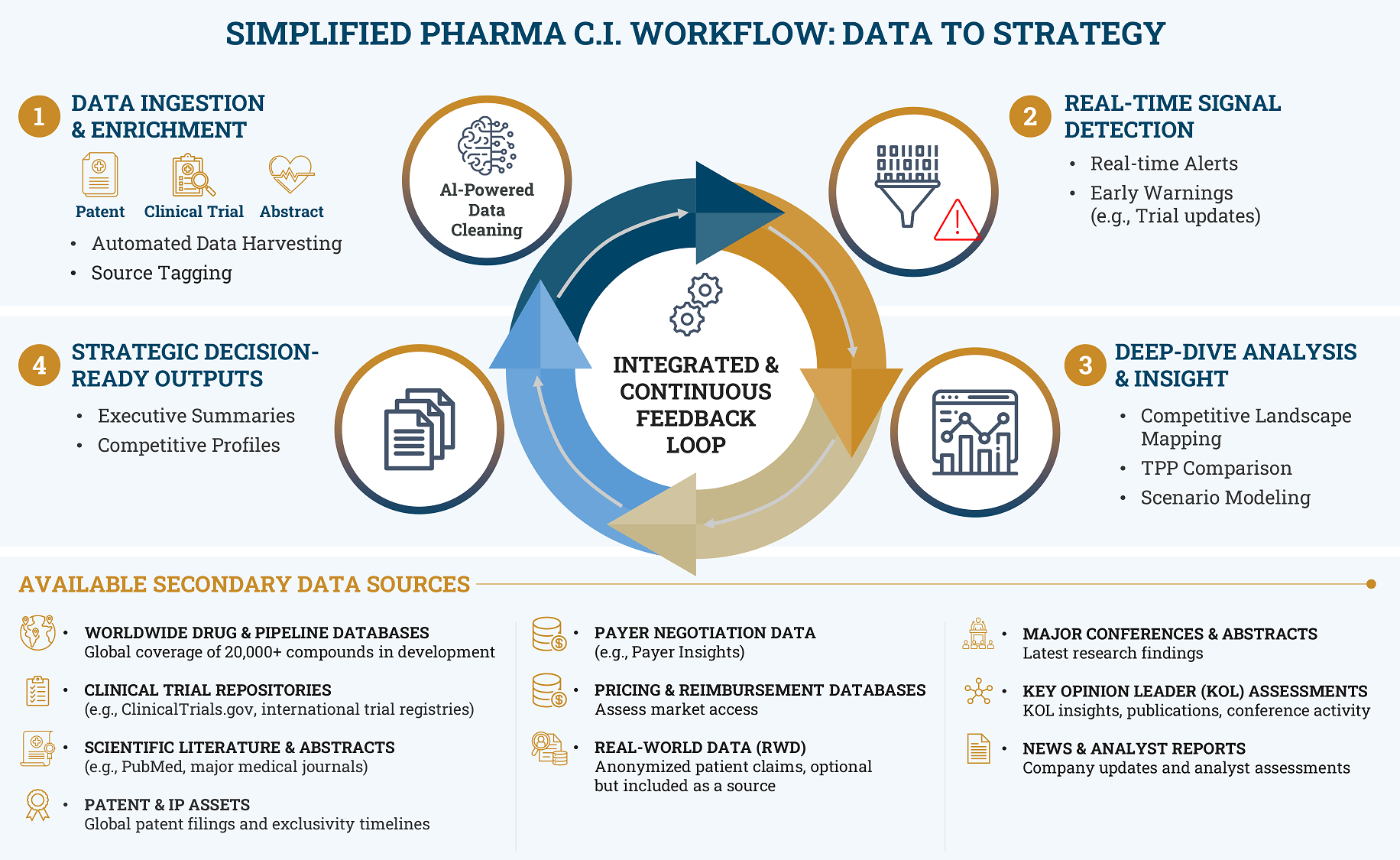
This approach ensures that intelligence influences action rather than simply informing stakeholders.
Outcome: Better decisions, not just better visibility
When CI works as intended, the impact is measurable.
- Faster decision cycles
- More accurate launch planning
- Reduced clinical risk
- Better allocation of capital
The greatest value of CI is helping organizations avoid decisions that no longer make strategic sense.
A contrarian view: Most CI teams are busy, not effective
Many organizations invest significant resources into CI and still struggle to demonstrate measurable business impact.
Success is frequently measured through activity rather than outcomes.
Common metrics include reports produced, alerts triggered, number of sources monitored and volume of intelligence collected.
While these indicators measure effort, they do not necessarily measure influence.
Effective CI may produce fewer outputs, but those outputs shape critical decisions involving portfolios, trials, launches, and investments.
How Chryselys Can Help with Competitive Intelligence in Pharma
Most organizations do not struggle with access to data but struggle with connecting it to decisions.
Chryselys helps address this gap through a practical and decision-oriented approach.
Key areas of support include:
- Building integrated intelligence ecosystems across clinical, regulatory, and commercial domains
- Establishing always-on monitoring linked to business-critical decision triggers
- Translating market signals into structured decision frameworks for portfolio, launch, and lifecycle strategy
- Identifying emerging risks and opportunities before they become material business issues
- Supporting scenario planning and competitive war-gaming initiatives
The objective is to improve decision quality, increase organizational agility, and help teams act with greater confidence.
Teams spend less time interpreting fragmented inputs and more time acting on validated insights.
The outcome is better decisions, made earlier, with greater strategic clarity and lower risk.
FAQs
1. How does competitive intelligence improve pharma launch success in crowded therapy areas?
Competitive intelligence improves launch success by identifying where and how to compete before market entry. It analyzes competitor trial design, positioning, patient segmentation, and stakeholder behavior to shape launch strategy. In practice, this enables better decisions on field force sizing, messaging, and access strategy. It also supports launch war-gaming, where teams simulate competitor responses. This reduces the risk of misaligned positioning and helps avoid overinvestment in segments where competitors already have an advantage.
2. What data sources do high-performing pharma CI teams use to predict competitor moves?
High-performing CI teams integrate multiple data sources rather than relying on a single feed. These include clinical trial registries, regulatory filings, patent databases, real-world data, claims data, primary research, and KOL insights. Social and digital signals are also increasingly relevant. The key is not access but integration. In practice, combining these sources allows teams to detect patterns such as shifts in trial design or market access strategy, which signal future competitor actions before they are formally announced.
3. How is AI changing pharma competitive intelligence, and what governance is required?
AI is accelerating data processing and pattern recognition in CI, enabling faster identification of signals across large datasets. It supports scenario modeling, trial optimization, and real-time monitoring. However, governance is critical. Regulatory bodies now expect transparency in how AI-driven insights are generated and used. In practice, this means documenting data sources, validating outputs, and ensuring context of use is clearly defined. AI enhances CI, but human interpretation remains essential for strategic decisions.
4. How does CI help pharma companies manage patent cliff and biosimilar risk?
CI helps manage patent cliff risk by providing early visibility into generic and biosimilar entry, competitor pipeline activity, and payer behavior. It tracks patent filings, litigation, pricing trends, and substitution patterns. In practice, this allows companies to act earlier by adjusting pricing strategy, accelerating lifecycle innovations, or shifting investment to alternative assets. The value lies in timing. Early insight enables proactive defense, while delayed insight leads to reactive and often ineffective responses.
5. What is the difference between competitive intelligence and regulatory intelligence in pharma?
Competitive intelligence focuses on understanding competitor strategy, pipeline activity, and market behavior. Regulatory intelligence focuses on how health authorities evaluate and approve products. The distinction is narrowing. In practice, effective decision-making requires both. For example, a competitor’s trial design only matters in the context of regulatory expectations. Integrating CI and regulatory intelligence allows teams to anticipate not just what competitors will do, but how regulators will respond, which directly impacts approval timelines and launch success.