

“Agentic AI” has become one of those phrases that shows up on nearly every pharma vendor’s homepage, often attached to products that are, on inspection, a chatbot with a new label. That gap matters, because the actual capability behind agentic AI in the pharma industry is different enough from a chatbot or a copilot that conflating the two leads to bad procurement decisions, misplaced trust, and eventually disappointment when a “GenAI agent” turns out to require the same manual babysitting as the tools it replaced. This article is an attempt to describe, concretely and without the hype, what agentic AI in pharma industry actually means, where it is being used today, what it cannot yet do safely, and what a realistic adoption timeline looks like.
What Agentic AI Actually Means, Versus a Chatbot or a Copilot
The terms “generative AI,” “copilot,” and “agentic AI” get used almost interchangeably in pharma marketing, but they describe meaningfully different levels of system autonomy. A generative AI chatbot responds to a single prompt with a single output: ask it to summarize a clinical trial protocol, and it summarizes the protocol you gave it. A copilot is a step further, usually embedded in a workflow, suggesting text, flagging anomalies, or drafting content that a human then edits and approves. Both are reactive. They wait for a person to specify exactly what to do next, at every step.
Beyond the chatbot: autonomous, multi-step reasoning and tool use
Agentic AI is built around a different loop. Instead of answering one question, it is given a goal, breaks that goal into a sequence of sub-tasks, decides which tools or data systems it needs to call to complete each sub-task, executes those calls, evaluates whether the result actually moved it toward the goal, and repeats until the goal is met or it reaches a point that requires a human decision. Concretely, that means an agent can query a clinical trials database, cross-reference the results against a site performance history system, pull enrollment data from a third source, reconcile discrepancies between them, and produce a ranked shortlist, all without a person re-prompting it after each individual step. The defining features are autonomous multi-step reasoning, the ability to call external tools and systems rather than just generate text, and the capacity to keep working toward a goal with minimal human input at each intermediate step.
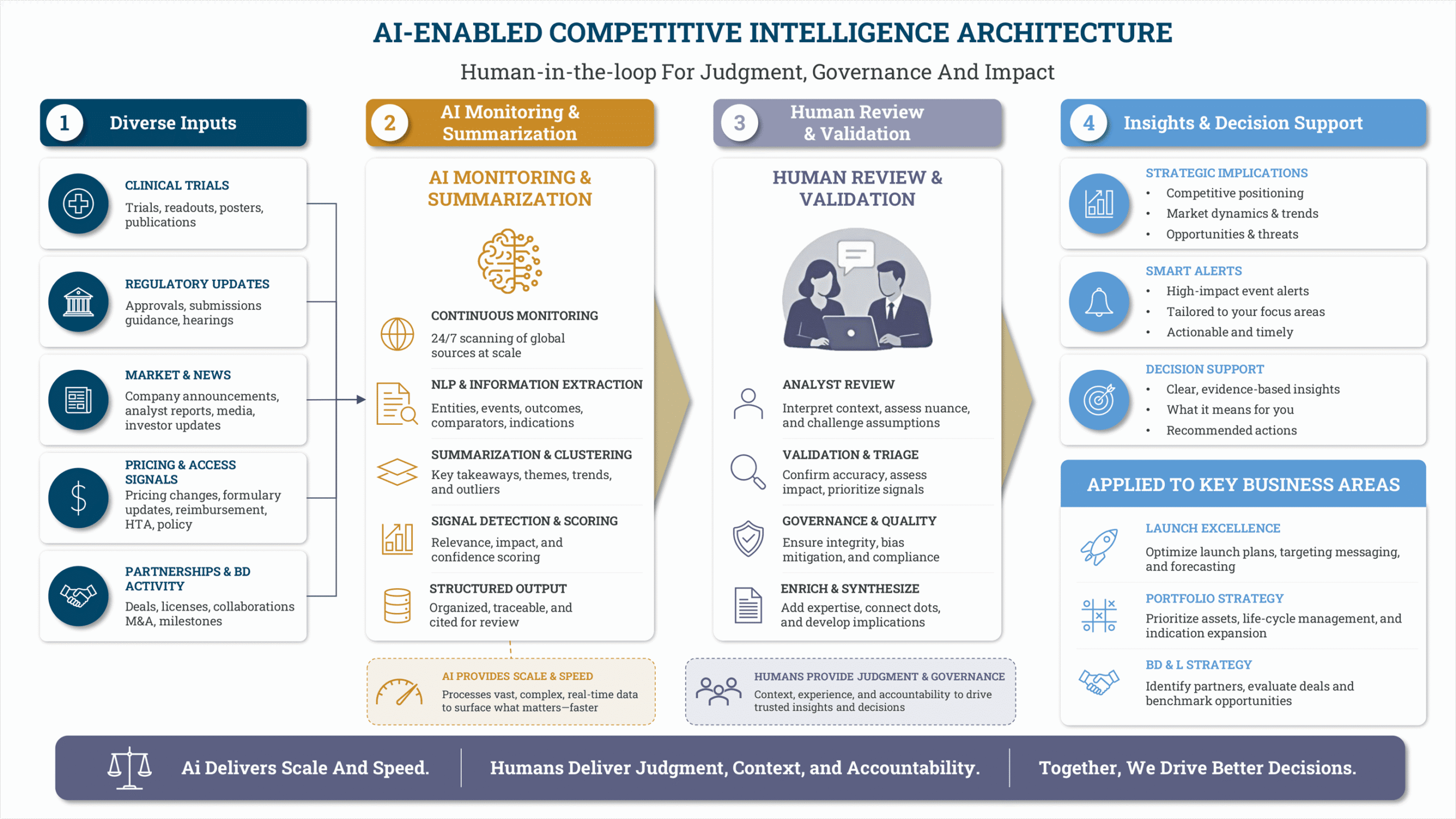
Why “copilot” and “agent” are not the same category of tool
This distinction is not academic. A copilot reduces the time it takes a person to do a task they were already going to do themselves. An agent takes over the execution of a task and hands back a completed piece of work, or a clearly flagged exception, for human review. That shift changes what an organization needs to govern. With a copilot, a human is in the loop by construction, because a human is driving every step. With an agentic system, human oversight has to be deliberately designed into the workflow at specific checkpoints, because the system is capable of running several steps unsupervised. Vendors who describe a single-turn generative tool as “agentic” are usually skipping this distinction, and it is worth pressing on in any vendor conversation: ask what the system does across multiple steps without a new prompt, not what it can answer when asked.
Where Agentic AI Applies in Pharma Today
Setting the definition aside, the more useful question for a pharma leader is where this actually shows up in day-to-day operations right now, not in a five-year roadmap. Four areas stand out as the ones where agentic approaches are furthest past the proof-of-concept stage: clinical operations, commercial execution, medical affairs, and demand forecasting.
Clinical: trial feasibility and investigator research automation
Trial feasibility work today involves a study team manually researching candidate investigators and sites: checking historical enrollment performance, therapeutic area experience, competing trial load, geographic and demographic fit against the protocol, and regulatory standing, usually across a half-dozen disconnected data sources and internal spreadsheets. This is exactly the kind of multi-step, multi-source research task that an agentic system can take over. An agent can be given a protocol’s inclusion criteria and target enrollment numbers, then autonomously query site performance databases, cross-check investigator publication and trial history, flag sites with scheduling conflicts, and return a ranked shortlist with the supporting evidence attached, rather than a set of raw search results a person still has to synthesize. Chryselys’ KYRA Clinical agent is built around this specific use case, automating the research and synthesis work in feasibility while leaving the final site selection decision with the clinical operations team.
Commercial: autonomous next-best-action execution and account research
On the commercial side, most field teams already have next-best-action recommendations surfaced to them inside a CRM. What is new with an agentic approach is that the system does not stop at the recommendation. It can research an account across call history, prescribing trends, formulary status, and recent field notes, decide what action makes sense given that context, and either execute lower-risk actions directly (queuing a targeted piece of approved content, updating a territory’s account tier, scheduling a follow-up) or hand a field rep a fully prepared recommendation with the reasoning attached, instead of a generic model score. Chryselys’ KYRA Commercial agent operates in this space, doing the account research and next-best-action legwork that a commercial analyst or field rep would otherwise assemble manually across multiple systems.
Medical affairs: literature synthesis and insight generation
Medical affairs teams spend a significant share of their time on literature surveillance: scanning new publications, congress abstracts, and real-world evidence for a therapeutic area, then synthesizing what is relevant into a digestible insight for medical science liaisons or internal stakeholders. An agentic workflow can continuously monitor new literature sources, filter for relevance against a defined therapeutic focus, extract and synthesize key findings, and surface a structured summary with citations back to the source material, refreshing the synthesis as new publications appear rather than requiring a person to re-run the search. This is a case where grounding matters enormously, since medical affairs content has a very low tolerance for unsupported claims, so any agent operating here needs retrieval tightly scoped to verified literature sources with citations that can be checked, not open-ended generation.
See how agentic AI applies to your data environment. If you are evaluating agentic AI for clinical, commercial, or forecasting workflows and want to understand what is realistic for your current data foundation, our team can walk through it with you.
Schedule a DemoForecasting: continuously monitoring and updating demand forecasts
Demand forecasting in pharma has traditionally been a periodic exercise: a forecast gets built, reviewed, and locked for a quarter or a planning cycle, then manually revisited when something goes wrong. An agentic approach treats forecasting as a continuous process instead of a periodic one. The agent monitors incoming signals, prescription trends, inventory movement, competitive launches, policy changes, and payer shifts, and when it detects a deviation from the current forecast that crosses a meaningful threshold, it can investigate the cause, adjust the model inputs, and flag a recommended forecast revision for a demand planner to approve, rather than waiting for the next scheduled review cycle to surface the issue. Chryselys’ ForecastIQ, part of the broader DataFusionIQ data platform, is built around this continuous-monitoring model, so that a forecast reflects current signal rather than the assumptions that were true when it was last built.
Risks and Guardrails in a Regulated Industry
None of the use cases above are safe to deploy without deliberate constraints, and any pharma organization deploying agentic AI in pharma industry settings should treat the guardrails as part of the product decision, not an afterthought bolted on after a pilot succeeds.
Data governance and system access
An agent that can query multiple systems and, in some workflows, take action inside them needs governance that goes beyond standard data access controls. That means explicit, role-scoped permissions for what each agent can read versus what it can write to, a full audit trail of every system call and data source an agent touched while completing a task, and clear boundaries around which systems are read-only for an agent and which allow it to take action. This is a harder governance problem than a traditional analytics tool presents, precisely because the agent’s path through the data is not fully predetermined at design time.
Compliance and MLR review
Any output that could influence promotional, medical, or regulatory content still has to go through Medical, Legal, and Regulatory review, and agentic AI does not change that requirement. What it can change is how much of the drafting and pre-checking work happens before content reaches a reviewer. An agent can assemble a first draft against approved claim libraries, flag statements that need a supporting reference, and check formatting against known regulatory templates. The review step itself remains a human, accountable function, and any deployment plan that treats MLR as optional because “the AI already checked it” is a compliance risk, not an efficiency gain.
Hallucination risk in a regulated industry
Large language models generate plausible text, and plausible is not the same as accurate. In consumer applications, a hallucinated fact is an inconvenience. In pharma, a fabricated efficacy claim, an invented citation, or a miscalculated dose comparison is a patient-safety and regulatory issue. The practical mitigation is grounding: agents used for anything that touches medical or regulatory content should retrieve from verified, licensed, and internally approved data sources rather than generating freely, and every substantive claim an agent produces should carry a traceable citation back to its source. Where that grounding is not possible or the source data is ambiguous, the agent should be designed to flag uncertainty and stop, not to fill the gap with a confident-sounding guess.
Human-in-the-loop requirements
Full end-to-end autonomy is not where the pharma industry is today, and it should not be the near-term goal for most use cases. A defensible agentic workflow builds in review checkpoints: a human reviews the agent’s task plan before it executes anything with compliance exposure, a human reviews the output before it leaves an internal system or informs a regulated decision, and a human retains the ability to interrupt or override the agent mid-task. Framed this way, the value of agentic AI is not removing people from the process, it is removing the manual research, synthesis, and coordination work that currently sits between a person and the decision they need to make.
Where Chryselys Fits
Chryselys’ approach to agentic AI in the pharma industry starts from the data layer rather than the interface layer, because an agent is only as reliable as the data it can act on. DataFusionIQ consolidates and standardizes the clinical, commercial, and real-world data that pharma agents depend on, so that an agent working a task is drawing from a coherent, governed data foundation instead of reconciling inconsistent formats across disconnected systems on the fly. On top of that foundation sits AIVY, Chryselys’ GenAI assistant platform, which is where the agentic capabilities described throughout this article, KYRA Clinical for trial feasibility and investigator research, KYRA Commercial for next-best-action and account research, and ForecastIQ for continuous demand forecasting, are built and deployed. The design principle across all of them is the same: automate the multi-step research and synthesis work that currently consumes specialist time, keep the accountable decision with a human, and make every step the agent takes auditable.
Adoption Maturity: A Realistic View Versus the Hype
It is worth being direct about where the industry actually stands, because the marketing language around agentic AI has moved faster than deployed capability. Most pharma organizations today are running agentic pilots in narrowly scoped workflows, commercial next-best-action and forecasting tend to be the most mature, because the underlying data is largely structured and the cost of an imperfect intermediate step is lower than in clinical or medical content. Clinical feasibility and investigator research automation are close behind. Medical affairs literature synthesis and anything touching promotional content are earlier stage, constrained by the accuracy bar that regulated content demands and by MLR review requirements that are not going away.
What is not yet common, despite how it is sometimes described in vendor materials, is a fully autonomous agent making unsupervised decisions that affect trial design, patient safety, or regulated commercial claims. That is a reasonable place for the industry to be. The technology that exists today is genuinely useful for compressing the research, synthesis, and coordination work that sits ahead of a decision, and pharma organizations that treat it that way, rather than as a replacement for clinical, commercial, or medical judgment, are the ones getting real value out of agentic AI in pharma industry work rather than a headline about it.
FAQs
1. How is agentic AI different from a chatbot or GenAI copilot we already use?
A chatbot or copilot answers a question or drafts something when a person prompts it, one exchange at a time. Agentic AI is given a goal, breaks it into steps on its own, calls tools or systems to complete those steps, checks its own intermediate output, and keeps going until the goal is met or it hits a point where it needs a human decision. The practical difference is who initiates each step: with a copilot, a person does, every time. With an agent, the system does, and a person reviews the outcome.
2. What data governance controls does agentic AI require that a standard analytics tool doesn’t?
Because an agent can read from and sometimes write to multiple systems in the course of a task, governance has to cover more than data quality. Pharma teams need role-based access scoped to what each agent is allowed to touch, an audit trail of every system call and data source the agent used to reach a conclusion, versioned data lineage so an output can be traced back to its source records, and clear separation between systems an agent can read versus systems it can act on. This matters more for agentic AI than for a single-turn tool because the agent’s path through the data is not fully predictable in advance.
3. Can agentic AI outputs go through MLR review, or does it bypass that process?
Agentic AI does not bypass Medical, Legal, and Regulatory review, and it should not be positioned that way. Any agent output that could become or influence promotional, medical, or regulatory content still needs to pass through the same MLR workflow as human-drafted material. What changes is where the agent sits: it can assemble a first draft, flag claims that need a reference, or pre-check content against approved claim libraries, which shortens the work in front of reviewers, but the review step itself stays intact and human-owned.
4. How real is the hallucination risk in a regulated industry like pharma?
It is real and it is the main reason agentic AI in pharma is deployed with narrower autonomy than in other industries. Large language models can generate plausible-sounding claims, citations, or data points that are not accurate. In a regulated setting, an unverified fabricated claim about efficacy or safety is not a minor error, it is a compliance and patient-safety issue. The mitigations that matter are grounding agent outputs in retrieval from verified internal and licensed data sources rather than open generation, requiring citations back to source documents, and keeping a human reviewer on any output that leaves the four walls of an internal workflow.
5. Where does human-in-the-loop review sit in an agentic AI workflow?
The honest answer is that human review sits at more checkpoints than most vendor demos suggest. A well-designed pharma agent workflow typically has a human review the agent’s task plan before execution for anything with compliance exposure, a human review the agent’s output before it is sent externally or used in a regulated decision, and a human able to interrupt or override the agent mid-task. Full autonomy end to end is not the current state of practice in pharma, and most enterprise buyers should be skeptical of any vendor claiming it is.
6. Which pharma functions are furthest along in adopting agentic AI today?
Forecasting and commercial operations tend to be furthest along, because the data feeding those workflows is largely structured (sales, claims, prescriber activity) and the cost of an imperfect intermediate step is lower than in clinical or medical content. Clinical trial feasibility and investigator research are close behind, since the research and synthesis steps are well suited to agentic automation even though the final decisions stay with clinical operations teams. Medical affairs and any workflow that touches promotional or regulatory content are earlier stage, because the accuracy bar and review requirements are higher.
7. Do we need a new data platform before we can use agentic AI, or can it work with what we have?
An agent is only as reliable as the data it can reach. If trial data, claims data, sales data, and literature sit in disconnected systems with inconsistent structure, an agent will spend most of its effort reconciling formats instead of reasoning toward an answer, and errors compound at each handoff. Most pharma organizations get more reliable agentic AI outcomes by first consolidating and standardizing their data foundation, then layering agents on top, rather than pointing an agent at a fragmented data environment and hoping it compensates.
8. What should we ask a vendor to tell the difference between real agentic AI and a rebranded chatbot?
Ask what tools or systems the product can actually call and act on, not just retrieve from. Ask whether it can complete a multi-step task without a person re-prompting it at every step, and ask to see that happen, not just hear it described. Ask what happens when the agent hits ambiguous input or missing data, since a real agent should recognize the limit and escalate rather than guess. And ask for a specific, named audit trail of a task the agent completed, including every source it touched. If a vendor cannot show a concrete multi-step task with tool calls and an audit trail, the term agentic is likely being used loosely.
9. How should a pharma IT leader think about ROI on agentic AI pilots given how early the technology is?
Scope pilots around tasks that are currently manual, repetitive, and time-consuming for a specialized team, such as investigator research for feasibility or literature scans for a therapeutic area, rather than end-to-end decision-making. Measure time saved on the research and synthesis steps, not accuracy on the final judgment call, since the judgment call should still involve a human. Treat the pilot as validating the data foundation and the human-in-the-loop workflow as much as validating the model, because those two factors determine whether the pilot scales or stalls when it moves beyond a single use case.
Conclusion
Agentic AI in the pharma industry is a real capability shift, not a rebrand of the copilot tools most organizations already have, but it is a shift with a narrower current scope than the marketing around it suggests. The organizations getting genuine value from it are the ones applying it to well-defined, high-effort research and synthesis tasks, trial feasibility research, commercial account research, literature synthesis, continuous forecasting, while keeping accountable human review on anything that touches a regulated or patient-facing decision. That combination, real autonomy on the tasks that tolerate it and disciplined oversight on the ones that don’t, is what separates a working deployment from a pilot that never leaves the sandbox.
Want to see how agentic AI could apply to your clinical, commercial, or forecasting workflows?
Talk to our team and schedule a demo