

The problem: intelligence arrives after the decision is already made
A commercial team finalizes launch messaging. Two weeks later, a competitor updates trial endpoints and shifts positioning. A BD&L team advances a licensing target. A month later, a similar asset is acquired at a lower valuation. A portfolio committee doubles down on an indication. Six months later, pricing pressure wipes out the upside.
None of these are rare failures. They are common outcomes when competitive intelligence (CI) exists like a reporting function but does not influence decisions in time as they are made elsewhere, often without CI at the table.
That gap is expensive. In 2025 and beyond, the pace of dealmaking, launch activity, and pricing shifts means late awareness is not a minor issue. It directly affects revenue, capital allocation, and risk exposure.
The companies getting this right are not collecting more data. They are building CI as a decision system.
Why most pharma CI programs fail in practice
Failure is rarely about lack of effort. It is structural.
CI is disconnected from decision forums
CI teams often sit within insights or research functions. Portfolio decisions sit with R&D leadership. Launch decisions sit with commercial. BD&L operates on its own timelines.
In practice, this means CI produces insights that arrive too late or do not map to the questions decision-makers are asking.
Too much focus on data, not implication
Most teams are good at tracking pipelines, trials, and news flow. The harder problem is answering:
- What does this change for our trial design?
- Should we accelerate or delay launch?
- Is this asset still worth acquiring?
Without clear implications, intelligence becomes noise.
Over-reliance on public sources
Public data is table stakes. Everyone has access to it. The advantage comes from primary intelligence. KOL feedback, investigator sentiment, payer signals, and field insights.
Many programs underinvest here because it is harder to structure and scale.
Static priorities in a dynamic market
Competitor lists, tracked assets, and reporting cycles often stay fixed. Meanwhile, deal activity shifts, new entrants appear, and therapeutic focus changes.
The result is effort spent on yesterday’s competition.
The business impact: where CI failures hurt most
CI gaps do not show up as missed reports. They show up as poor decisions.
Launch underperformance
If competitor messaging, access strategy, or clinical positioning shifts late, launch plans become misaligned. This leads to slower uptake and lower peak sales.
Weak BD&L decisions
With licensing spend rising sharply and deal structures becoming more selective, missing valuation signals or partner risks leads to overpaying or backing the wrong assets.
Portfolio misallocation
When capital pressure increases, companies need to prune aggressively. Without clear competitive context, weak assets stay funded too long.
Pricing and access surprises
Payer expectations and pricing corridors are shifting faster than before. Late insight here directly impacts revenue.
What works: building CI as a decision system
The shift is not about better dashboards. It is about how CI operates inside the business.
1. Anchor CI to decisions, not topics
Start with the decisions that matter:
- Which assets to prioritize
- When and how to launch
- Which deals to pursue
- How to position on pricing and access
Then define what intelligence is required to support those decisions.
In practice, this means CI output should map to specific forums. Portfolio reviews, launch readiness meetings, BD&L screens.
If CI is not present in those forums, it is not influencing outcomes.
2. Define clear ownership from signal to action
A working CI model answers four questions:
- Who captures signals
- Who validates them
- Who interprets implications
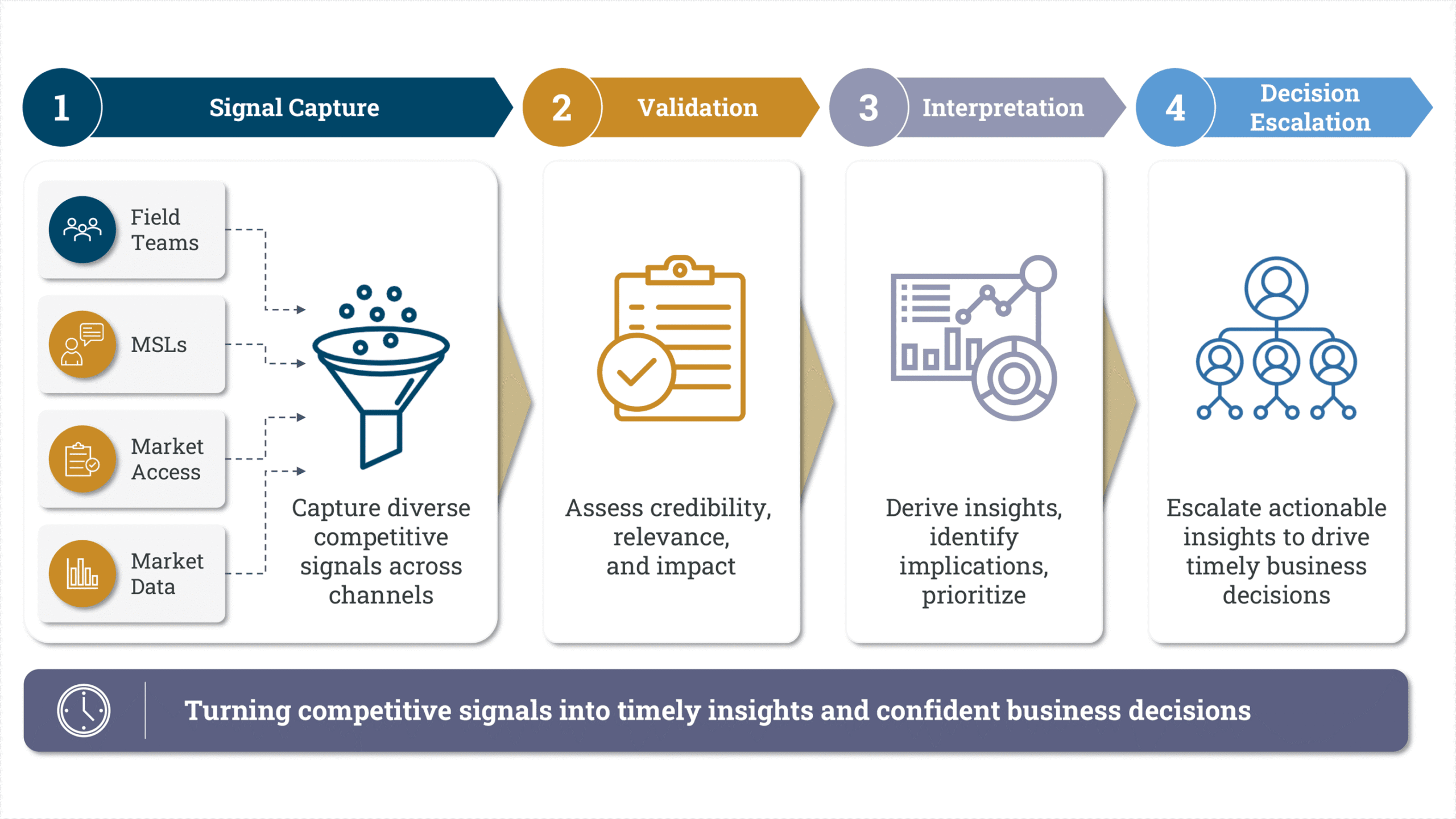
In practice, signal capture is distributed. Field teams, MSLs, and market access teams all see different parts of the market.
Interpretation should be centralized enough to maintain consistency, but close enough to the business to stay relevant.
Escalation paths must be explicit. If a signal changes a decision, it should trigger immediate review.
3. Invest in primary intelligence, not just monitoring
Secondary research tells you what happened. Primary intelligence tells you what might happen next.
High-value sources include:
- KOL perspectives on emerging data
- Investigator feedback on trial feasibility
- Payer reactions to evidence packages
- Field insights on competitor messaging
The challenge is structure. Without a system to capture and validate these inputs, they remain anecdotal.
In practice, companies that win here create structured feedback loops from field and medical teams into CI.
4. Focus on signals that actually change strategy
Not all signals matter equally.
High-impact signals include:
- Changes in trial design or endpoints
- Regulatory posture shifts
- Patent and IP movements
- Licensing and partnership activity
- Pricing and access outcomes
Low-impact signals are often over-tracked because they are easy to collect.
The discipline is to prioritize signals based on decision impact, not availability.
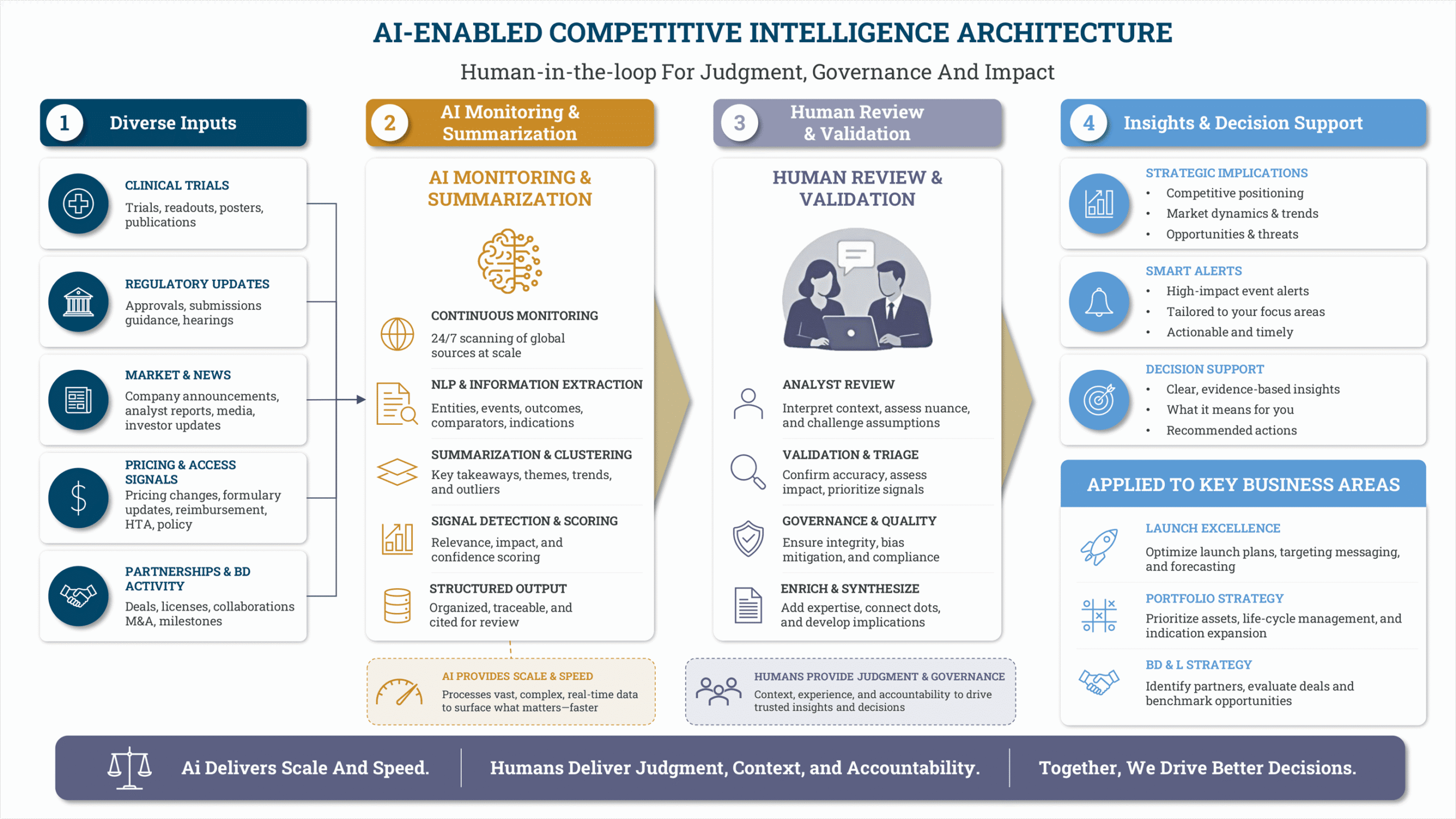
5. Use AI for scale, not judgment
AI is already improving CI in two areas:
- Continuous monitoring across large data sets
- Automated summarization and filtering
Emerging models are moving toward agent-based systems that track signals and trigger alerts.
But AI also creates risk. It amplifies noise, reinforces bias, and can over-summarize without context.
In practice, the best teams use AI to reduce manual effort, but keep human analysts focused on interpretation and decision support.
6. Integrate CI into planning cycles
CI should not operate on a reporting calendar. It should align with:
- Portfolio planning cycles
- Launch readiness milestones
- BD&L screening timelines
- Evidence generation planning
This ensures intelligence is delivered when it can influence decisions.
In practice, this often requires redesigning CI workflows to match business rhythms rather than internal schedules.
CI for capital allocation: where it matters most
One of the most underused applications of CI is capital allocation.
Pharma companies are facing increasing cost pressure, with expectations to reduce billions in expenses over the next decade.
At the same time, licensing activity is rising, and dealmaking is becoming more targeted.
This creates a narrow margin for error.
CI can directly inform:
- Which assets to fund or deprioritize
- Which indications to pursue
- Where to in-license versus build internally
- When to exit or partner
The key is linking competitive context to financial decisions. Not just describing the landscape, but quantifying risk and opportunity.
A contrarian view: more data can make CI worse
There is a tendency to believe that more data improves intelligence.
In practice, the opposite is often true.
Too much data leads to:
- Signal dilution
- Slower decision-making
- Confirmation bias through selective interpretation
The advantage is not volume. It is clarity.
Strong CI programs are defined by what they choose to ignore.
Measuring CI impact: what actually matters
Output metrics do not reflect value.
Counting reports, alerts, or dashboards does not show whether CI influenced decisions.
More meaningful metrics include:
- Time from signal detection to decision impact
- Number of decisions influenced by CI
- Revenue or cost implications of those decisions
- Reduction in decision cycle time
In practice, this requires close alignment with leadership forums. CI teams need visibility into how their input changes outcomes.
Common execution mistakes to avoid
- Treating CI as a support function instead of a strategic one
- Failing to connect CI to decision-making forums
- Over-indexing on tools instead of operating model
- Underinvesting in primary intelligence
- Using AI without governance or validation
- Measuring activity instead of impact
Each of these reduces the value of CI, even if the underlying data is strong.
The outcome: what a mature CI program delivers
When CI is built as a decision system, the impact is clear:
- Faster response to competitive shifts
- More confident portfolio and BD&L decisions
- Stronger launch performance
- Better alignment across R&D, commercial, and access teams
Most importantly, decisions improve because they are based on forward-looking implications, not backward-looking summaries.
How Chryselys Can Help with Competitive Intelligence in Pharma
The success of a CI program is determined less by the tools it uses and more by the operating model that drives it.
Chryselys focuses on closing the gap between signal and decision. This includes structuring cross-functional intelligence flows, embedding CI into planning forums, and ensuring insights translate into action.
The emphasis is on practical execution. How field intelligence is captured. How signals are validated. How implications are developed quickly enough to matter.
The result is not more reporting. It is faster, more confident decisions across launch, portfolio, and BD&L, with clearer visibility into risk and opportunity.
FAQs
1. How do you build a pharma CI program that actually changes decisions?
Start by anchoring CI to specific decisions such as portfolio prioritization, launch planning, and BD&L screening. Define clear ownership across signal capture, validation, interpretation, and escalation. Embed CI into governance forums where decisions are made, not after the fact. Focus on implication development rather than data collection. In practice, this means aligning CI workflows with business cycles and ensuring outputs directly answer strategic questions, with clear recommendations tied to revenue, risk, or capital allocation impact.
2. What should a biopharma CI team prioritize first: pipeline, pricing, access, or deals?
Prioritization should follow business context. For early-stage companies, pipeline and clinical trial intelligence matter most. For commercial-stage assets, pricing and market access signals are critical. In the current environment, licensing and deal intelligence is increasingly important due to rising in-licensing activity and selective capital deployment. The right approach is dynamic prioritization based on where value is at risk, rather than a fixed tracking model across all domains.
3. How do leading pharma companies use AI in competitive intelligence without losing judgment?
They use AI for scale and speed, not interpretation. AI handles continuous monitoring, data aggregation, and summarization across large datasets. Human analysts focus on validating sources, identifying high-impact signals, and translating them into strategic implications. Strong governance is critical, including source validation, bias checks, and escalation rules. This human-in-the-loop model ensures that AI enhances efficiency without compromising decision quality or introducing noise.
4. How do you measure CI ROI in pharma?
Measure impact, not activity. Key metrics include time-to-insight, number of decisions influenced, and financial outcomes such as revenue uplift, cost avoidance, or improved deal valuation. Another useful metric is reduction in decision cycle time due to faster access to validated intelligence. In practice, this requires tracking CI involvement in governance forums and linking insights to specific decisions, rather than relying on output metrics like reports or alerts.
5. How do pharma teams use primary intelligence effectively while staying compliant?
Primary intelligence must be structured, documented, and compliant with legal and ethical standards. This includes clear guidelines on what can be collected, validated sourcing, and proper anonymization where required. Field teams, MSLs, and market access teams should use standardized capture frameworks to ensure consistency. The goal is to convert qualitative insights into decision-grade intelligence without crossing regulatory boundaries, maintaining both strategic value and compliance integrity.