

Pharmaceutical companies invest heavily in CRM platforms, regulatory systems, analytics, digital engagement, automation, and artificial intelligence. Yet the success of these investments often depends on something less visible: whether the organization can consistently identify its customers, products, organizations, locations, and reference values across systems.
That is the role of master data management.
Master data management in pharma establishes trusted identities, definitions, relationships, and governance controls for critical business entities. It determines whether two records represent the same healthcare professional, whether a product has the correct regulatory status, whether an HCP belongs to the right healthcare organization, and whether downstream platforms interpret a reference value consistently.
When this foundation works, business processes connect naturally. When it fails, every downstream system inherits the problem.
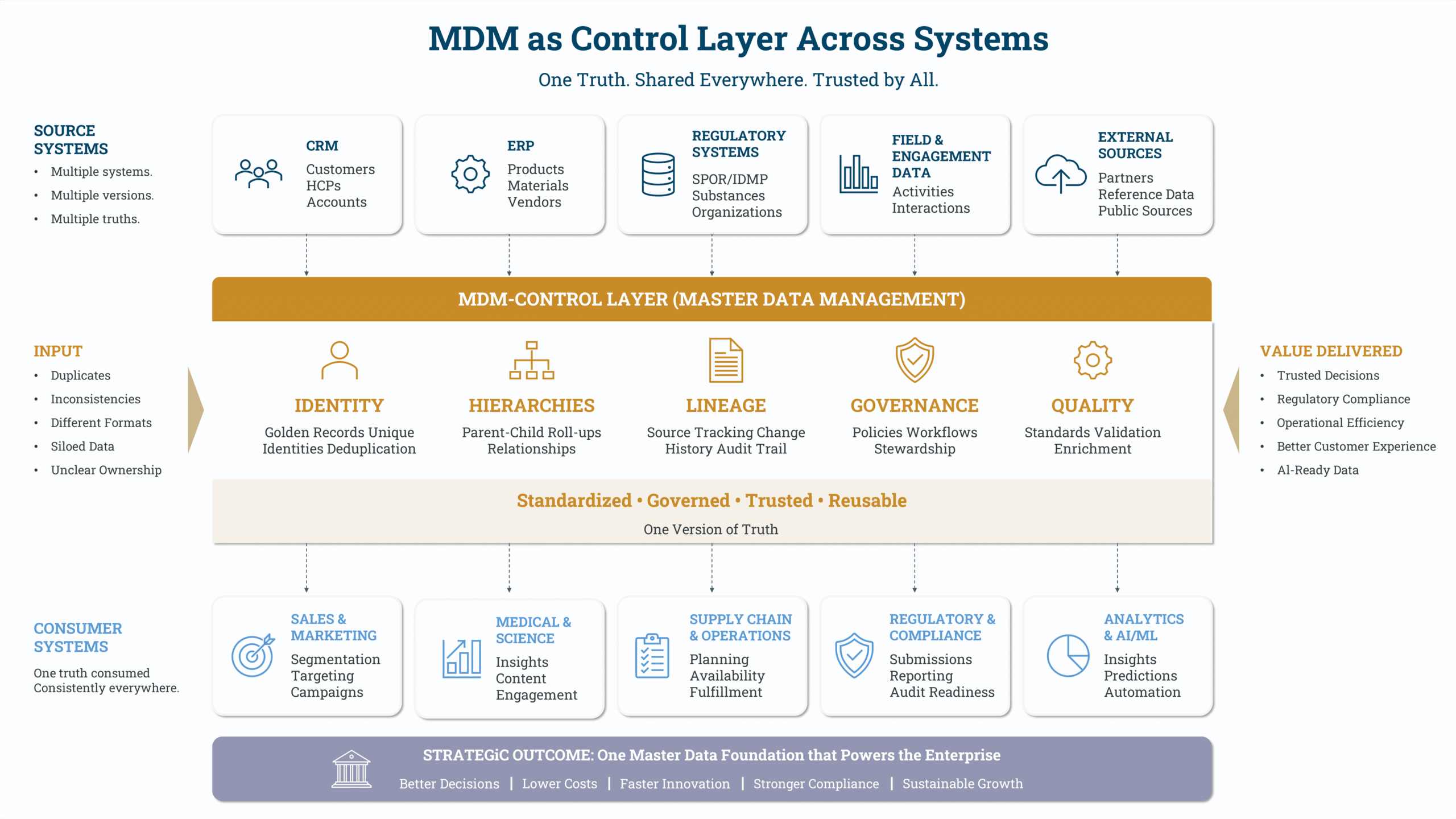
What Is Master Data Management in Pharma?
Master data management is the combination of governance, processes, business rules, technology, and stewardship used to create and maintain trusted master records.
In a pharmaceutical organization, these records commonly cover:
- Healthcare professionals and other individual stakeholders
- Healthcare organizations, hospitals, clinics, pharmacies, and accounts
- HCP-to-HCO affiliations and organizational hierarchies
- Products, brands, substances, presentations, pack, and materials
- Suppliers, vendors, manufacturers, and distribution partners
- Locations and addresses
- Reference data such as specialties, degrees, organization types, product statuses, countries, and communication channels
An MDM platform can identify duplicates, apply survivorship rules, validate attributes, maintain relationships, record lineage, and distribute trusted data. However, technology alone does not create a successful MDM program.
The organization must also decide who owns each data domain, which sources are authoritative, which changes require approval, how local requirements will be handled, and what should happen when systems disagree.
That operating model is where many pharma MDM programs either succeed or stall.
Why Master Data Becomes Difficult in Pharma
Pharma data operates across countries, functions, external providers, regulations, and technology platforms. The same entity may be represented differently depending on the purpose of a system.
A commercial CRM may view a hospital as an account. A regulatory platform may treat it as an organization connected to a product authorization. A medical system may focus on investigators, study sites, and scientific affiliations. A finance or ERP platform may maintain the same organization as a customer, supplier, or payment entity.
Each representation may be valid within its own process. The challenge is determining where the identities overlap, which attributes should be shared, and where contextual differences must remain.
This creates recurring problems:
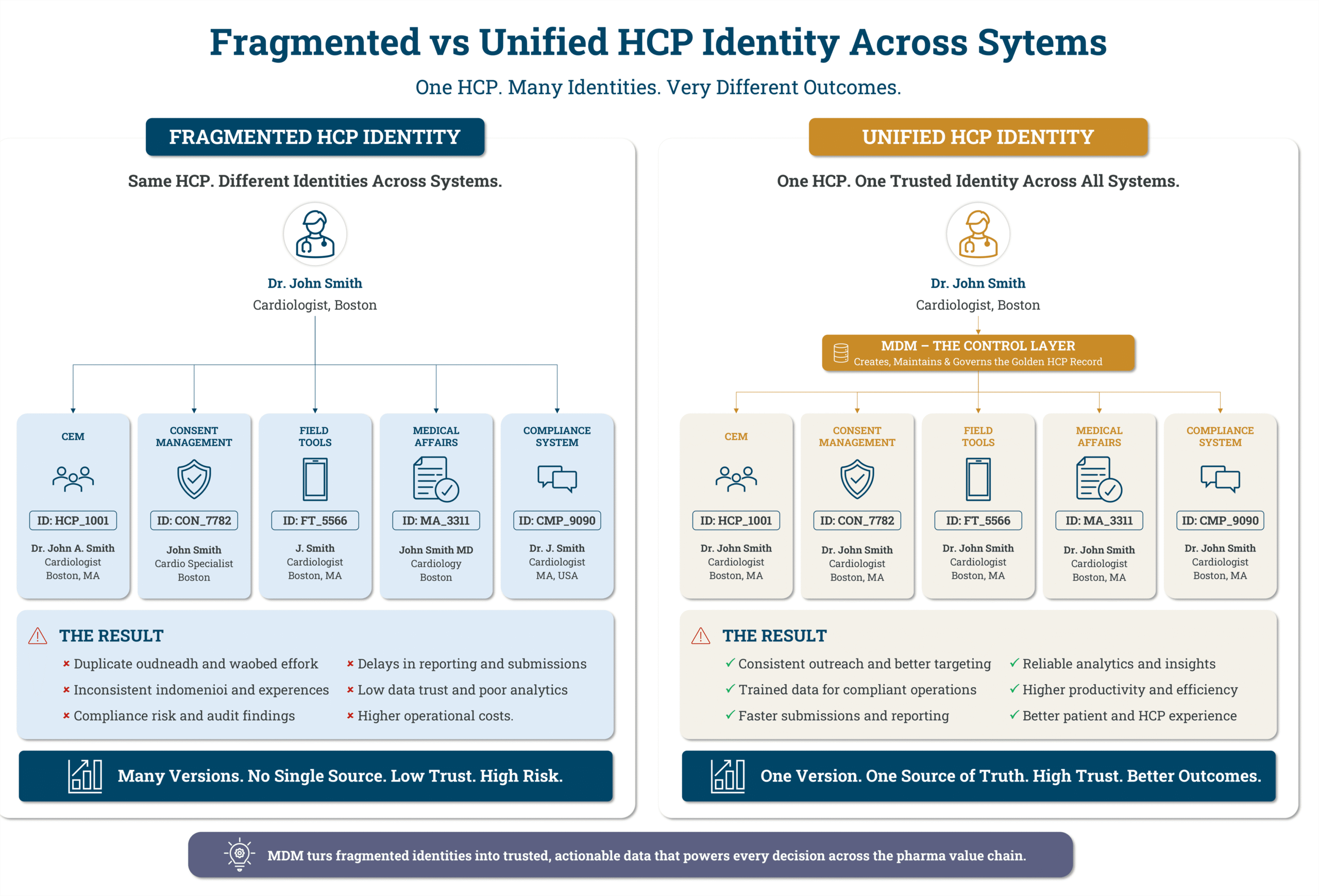
- Duplicate HCP and HCO records
- Conflicting identifiers
- Inconsistent product definitions
- Incorrect or outdated addresses
- Missing or contradictory affiliations
- Different reference codes for the same business concept
- Unclear source ownership
- Manual reconciliation between applications
- Slow data-change request processing
- Limited visibility into why a value was selected
These are not isolated data defects. They directly affect business execution.
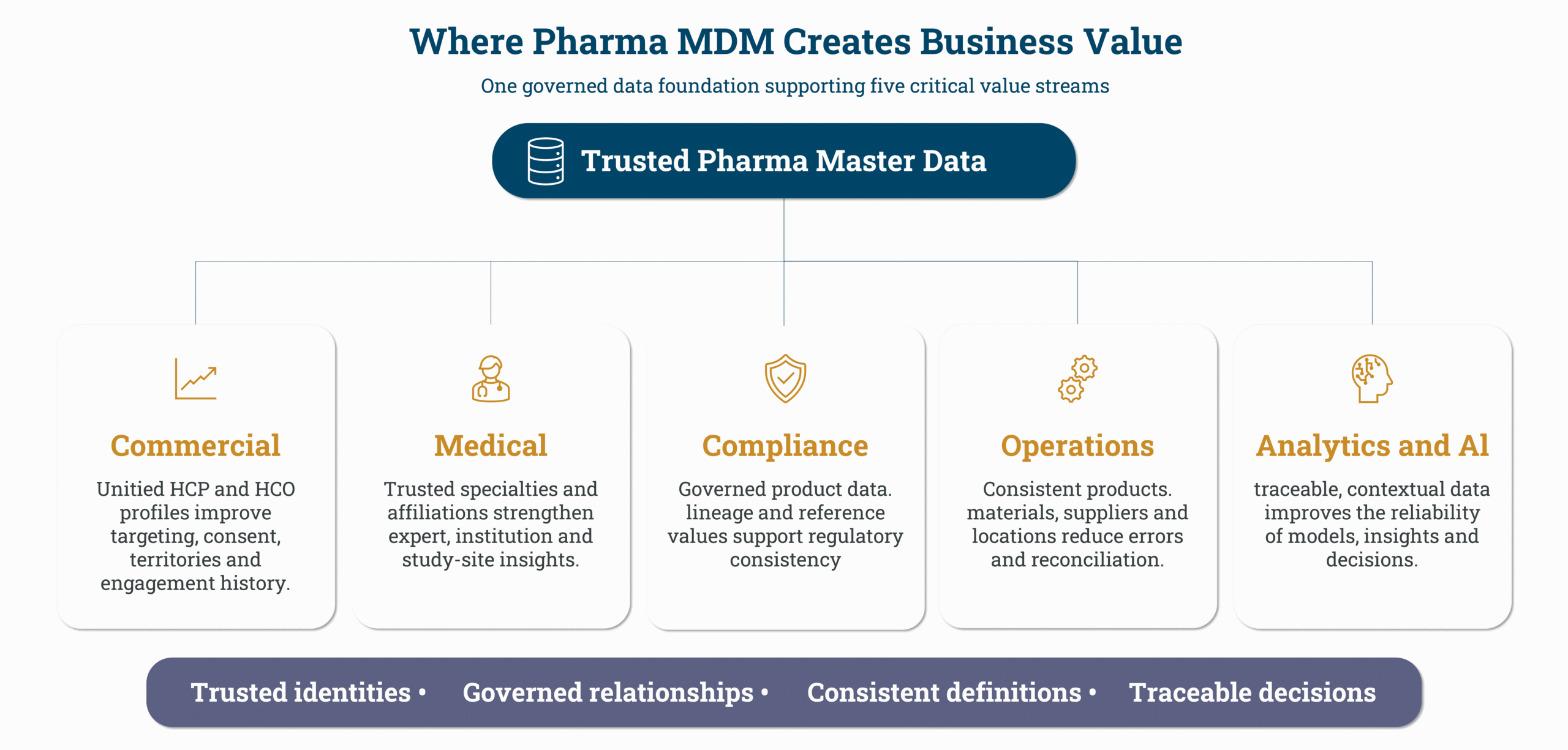
Where Pharma MDM Creates Business Value
Master data management connects trusted identities, relationships and definitions to the processes that drive commercial performance, compliance, operations and AI.
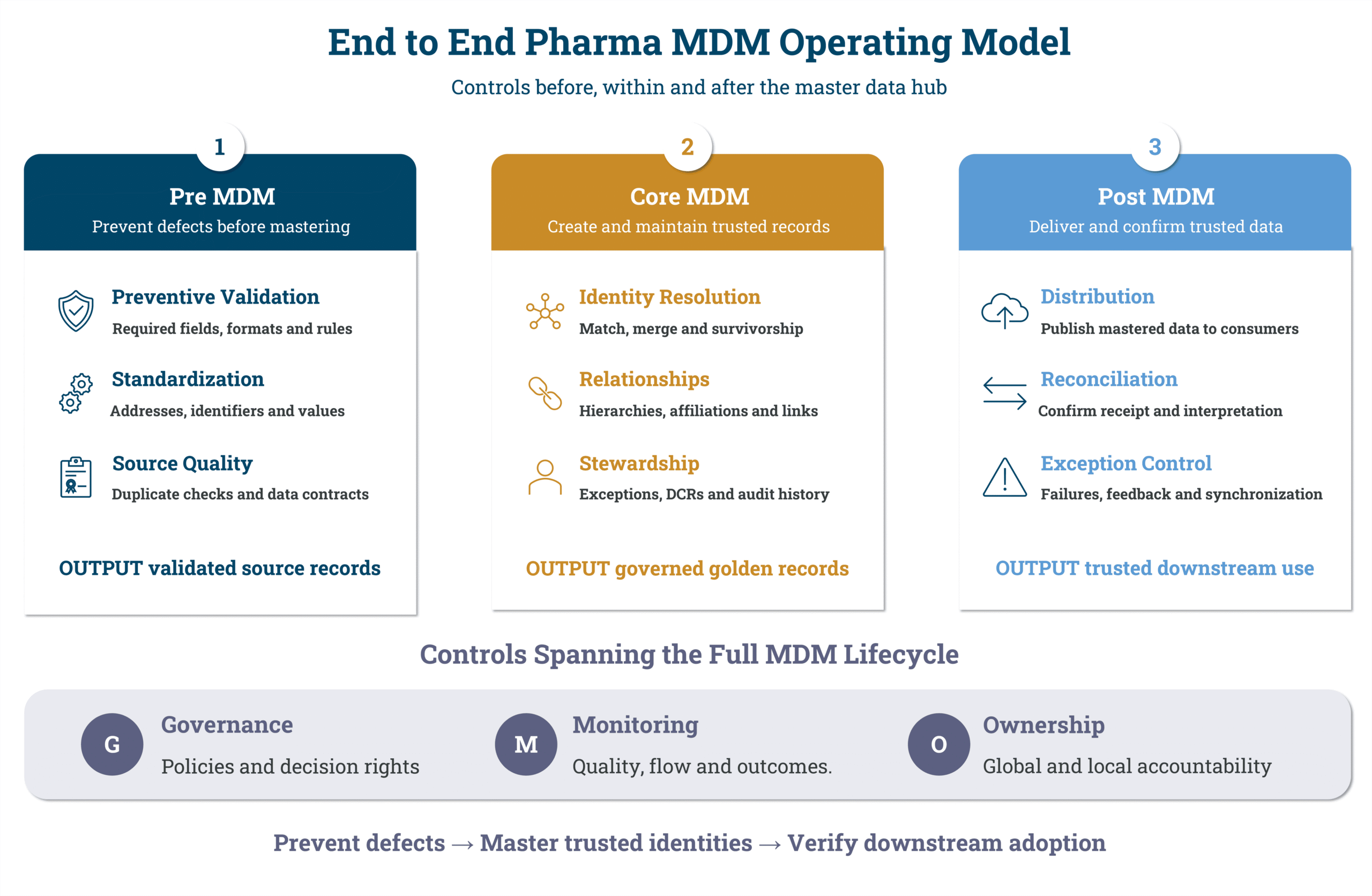
The MDM Operating Model That Actually Works
A sustainable pharma master data management program usually spans three connected layers.
Pre MDM Controls
Pre-MDM controls improve data before it enters the core mastering environment.
They may include:
- Mandatory-field validation
- Standardized formats
- Controlled reference values
- Source-level duplicate checks
- Address validation
- Identifier validation
- Data-contract monitoring
- Source-specific quality rules
Preventing a defect is usually more efficient than repeatedly correcting it after mastering.
Core MDM Controls
Core MDM resolve’s identity, applies governance rules, and maintains trusted entities.
Typical capabilities include:
- Match and merge
- Suspect-record management
- Survivorship
- Hierarchies and relationships
- Crosswalks and identifiers
- Data-change requests
- Stewardship workflows
- Lineage and audit history
- Reference-data management
These rules must remain explainable. A high match score should support a decision, not replace the need to understand why two records were considered the same.
Post MDM Controls
Publishing a golden record is not the end of the process.
Post-MDM controls confirm that consuming systems received, interpreted, and applied the mastered information correctly. They include:
- Distribution monitoring
- Reconciliation
- Failed-message handling
- Downstream code translation
- Synchronization controls
- Deletion and inactivation handling
- Consumer feedback
- Data-quality measurement
Without post-MDM controls, the mastered record may be accurate in the hub while downstream systems continue using inconsistent data.
Where Pharma MDM Programs Commonly Fail
Treating MDM as a Technology Installation
An MDM platform can automate rules, but it cannot determine business ownership or resolve organizational disagreement.
Programs struggle when implementation begins before the organization defines its domains, decision rights, authoritative sources, and measurable outcomes.
Focusing Only on Duplicate Removal
Deduplication is important, but it is only one part of MDM. A unique record can still contain an incorrect specialty, outdated address, invalid product status, or incomplete affiliation.
Successful programs manage identity, attributes, relationships, reference values, and lifecycle events together.
Allowing Reference Data to Proliferate
New canonical values are sometimes created because a source label looks different, even when an existing value represents the same concept.
Before adding a value, teams should determine whether the difference is semantic, linguistic, regulatory, or merely technical. They should also identify which countries and systems use the value and whether a governed alternative already exists.
Applying Global Standards Without Local Input
Global standards create scale, but affiliates understand local regulations, terminology, sources, and business processes.
The strongest operating model combines global ownership with structured affiliate participation. Local variation should be justified and governed rather than automatically rejected or accepted.
Relying on Stewardship as the Primary Control
Data stewards are essential, but manual queues should not become the default destination for every uncertainty.
Rules should automatically approve low-risk, high-confidence changes where appropriate. Stewardship should focus on material exceptions, ambiguous matches, policy decisions, and scenarios that require contextual judgment.
Measuring Activity Instead of Outcomes
The number of reviewed records does not show whether MDM is improving the business.
A useful measurement framework connects operational metrics with outcomes:
- Duplicate rate and false-merge rate
- Match precision and recall
- Data-change request turnaround time
- Stewardship backlog and ageing
- Attribute completeness and validity
- Downstream reconciliation failures
- Percentage of records with traceable provenance
- Adoption of canonical reference values
- Improvement in a defined business or compliance process
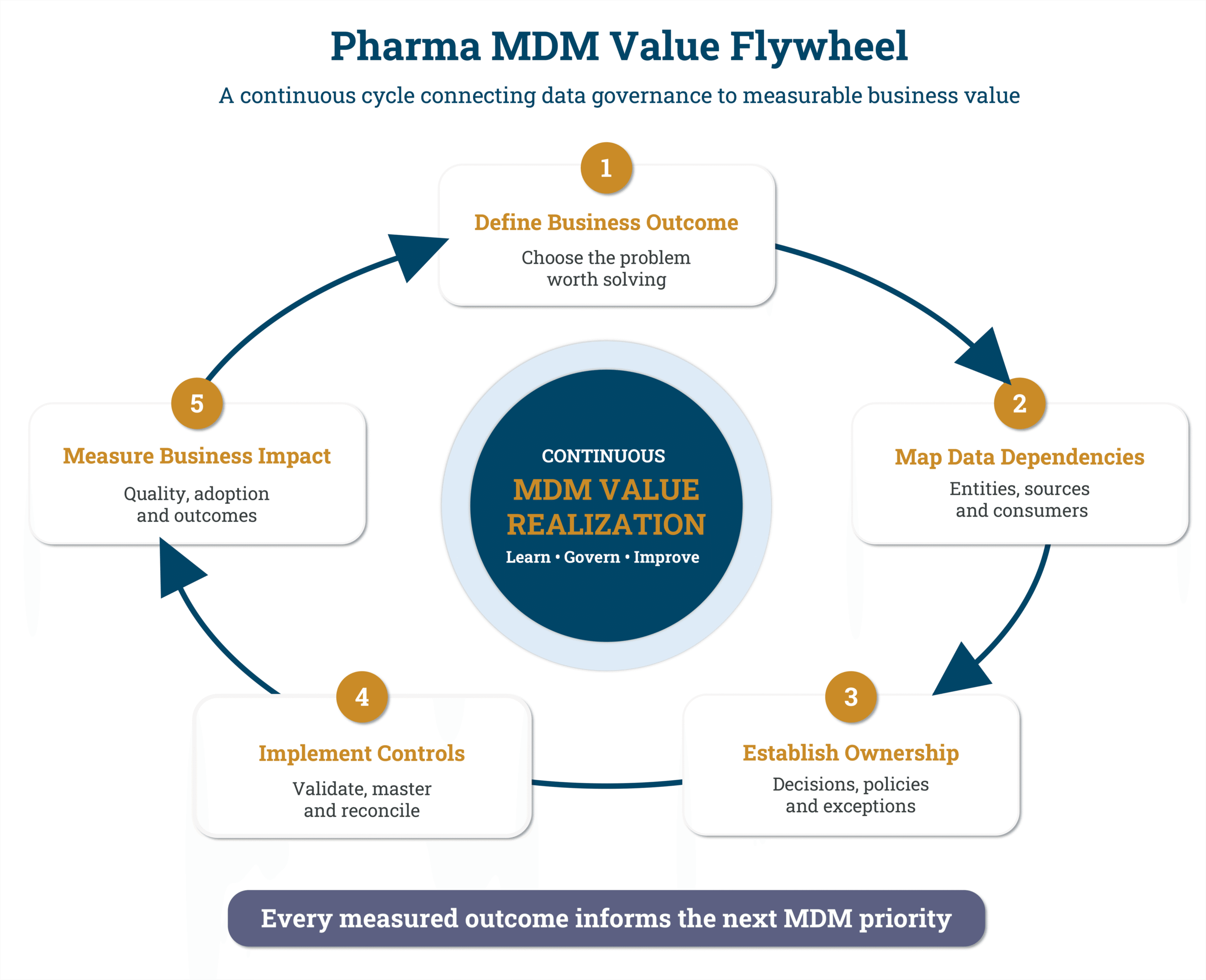
The Pharma MDM Value Flywheel
Effective MDM is not a one-time implementation. It is a continuous cycle that connects business priorities, data dependencies, governance, lifecycle controls and measurable outcomes—using each result to guide the next improvement.
MDM Is Becoming a Business Control Layer
The most mature organizations do not treat MDM as another repository. They use it as a control layer across the enterprise.
This layer determines:
- Which real-world entity a record represents
- Which values are trusted
- How records and concepts are related
- Where information originated
- Who can approve a change
- Which systems receive the change
- How the organization proves that the process worked
This is why MDM affects far more than data quality. It influences commercial execution, regulatory consistency, operational efficiency, analytics reliability, and the credibility of AI-enabled decisions.
The Question Pharma Leaders Should Ask
The central question is not whether the organization owns an MDM platform.
It is whether people and systems can consistently understand the same customer, product, organization, and business concept across the enterprise.
If the answer varies by system, function, or country, the organization does not yet have a technology problem alone. It has an enterprise governance and operating-model problem.
Master data management provides the structure required to solve it.
The unseen system becomes valuable when it allows every visible system to work from identities, relationships, and definitions that the business can understand and trust.
Chryselys help pharmaceutical organizations strengthen customer, product, reference-data, governance, and integration capabilities. Our approach connects MDM strategy with practical implementation controls and measurable business outcomes.
Frequently Asked Questions (FAQ)
1. Which MDM platforms are commonly used in the pharmaceutical industry?
Pharmaceutical and life sciences companies use a range of enterprise MDM platforms depending on their data domains, architecture, governance model, and integration requirements. Common platforms include Reltio, Informatica MDM, SAP Master Data Governance, Veeva Network MDM, Semarchy, Stibo Systems, Profisee, and other enterprise MDM solutions. Reltio and Veeva, for example, offer capabilities and configurations specifically designed for life sciences use cases such as HCP, HCO, product, affiliation, and reference-data management.
2. What is a golden record in Master Data Management?
A golden record is the trusted representation of a business entity created by combining information from multiple source systems. Matching, survivorship, source priority, validation, and governance rules determine which information becomes part of that trusted record. A golden record should also retain lineage so organizations can understand where each piece of information originated.
3. What is the difference between Master Data Management and Data Governance?
Master Data Management focuses on creating and maintaining trusted master records across systems, while data governance establishes the policies, ownership, standards, roles, and decision rights governing that data. MDM provides the operational mechanisms for mastering data, while governance determines how that data should be managed and who is accountable for it.
4. What is the difference between Master Data Management and Reference Data Management?
Master Data Management primarily manages core business entities such as HCPs, HCOs, products, suppliers, and locations. Reference Data Management manages controlled classifications and code sets used to describe those entities, such as specialties, organization types, product statuses, communication channels, countries, and other standardized values. Reference data is often governed alongside MDM to ensure consistent interpretation across systems.
5. How does MDM integrate with CRM platforms such as Veeva or Salesforce?
MDM typically acts as a trusted customer-data layer that exchanges mastered HCP, HCO, address, affiliation, identifier, and reference data with CRM systems. Changes initiated in the CRM may also be submitted back to the mastering environment through data-change workflows. Veeva Network MDM, for example, can integrate directly with Veeva CRM and Vault CRM to synchronize HCP/HCO information and support data-change requests.
6. What is a Data Change Request (DCR) in MDM?
A Data Change Request is a request to create, update, inactivate, or correct master data. For example, a field user may request a change to an HCP’s address, specialty, organization, or affiliation. Depending on the organization’s governance model and confidence level, the request may be automatically validated, routed to a data steward, sent to an external data provider, or rejected.
7. How are duplicate HCP and HCO records identified in MDM?
MDM platforms use matching rules to compare attributes such as names, addresses, professional identifiers, specialties, organizations, and other contextual information. Matching may use deterministic rules, fuzzy matching, probabilistic techniques, or machine-learning-assisted entity resolution. High-confidence matches may be processed automatically, while ambiguous cases can be routed to data stewards for review.
8. What is survivorship in Master Data Management?
Survivorship determines which value should be considered trusted when multiple systems provide different values for the same attribute. Rules may consider source reliability, recency, completeness, verification status, or other business criteria. Modern MDM platforms can apply survivorship dynamically so the most appropriate value is selected while retaining the original source information and lineage.
9. How does MDM manage HCP-to-HCO affiliations and organizational hierarchies?
MDM can maintain relationships between healthcare professionals and healthcare organizations, such as employment, practice, membership, or other professional affiliations. It can also represent relationships between organizations, such as hospitals, clinics, parent organizations, and healthcare networks. These relationships help downstream systems understand not only who an HCP or HCO is, but also how entities are connected. Life-sciences-focused MDM platforms commonly support HCP/HCO affiliations and hierarchy management as part of customer mastering.